
Table of Contents
- Why Interactive Team Building Activities Matter for Corporate Groups
- Chocolate-Making Workshops: Hands-On Team Bonding
- Indoor Team Building Activities for Large Groups
- Outdoor Team Building Adventures
- Team Building Event Planning Tips for Success
- Understanding Team Building Activity Duration and Scheduling
- Budget-Friendly and Premium Options for Every Group Size
- Frequently Asked Questions
Last Updated: August 30, 2026
Why Interactive Team Building Activities Matter for Corporate Groups
Interactive team building activities create moments where people genuinely collaborate, laugh together, and remember why they work well as a unit. At International Chocolate Events, we’ve seen firsthand how hands-on experiences reshape team dynamics. A group that arrives disconnected can leave energised, having discovered unexpected strengths in colleagues.
Corporate groups benefit most when interactive team building activities are thoughtfully chosen. Large organisations with 40, 60, or 100+ employees face unique challenges: how do you create meaningful connection at scale while ensuring every person feels included? Poorly planned activities can damage morale, leaving people feeling rushed, excluded, or bored.
Teams that invest in structured bonding experiences report stronger collaboration, improved communication, and measurably better retention (peer-reviewed research). The activities that stick are those where people create something tangible, solve something real, or push themselves slightly beyond their comfort zone in a supportive environment.
Chocolate-Making Workshops: Hands-On Team Bonding
A chocolate-making workshop transforms a corporate event from “something we have to attend” into “something we’ll actually talk about.” Unlike trust falls or icebreaker games, a chocolate workshop gives your team a genuine reason to work together. Participants learn proper tempering technique, experiment with flavour combinations, and leave with something they’ve actually created.
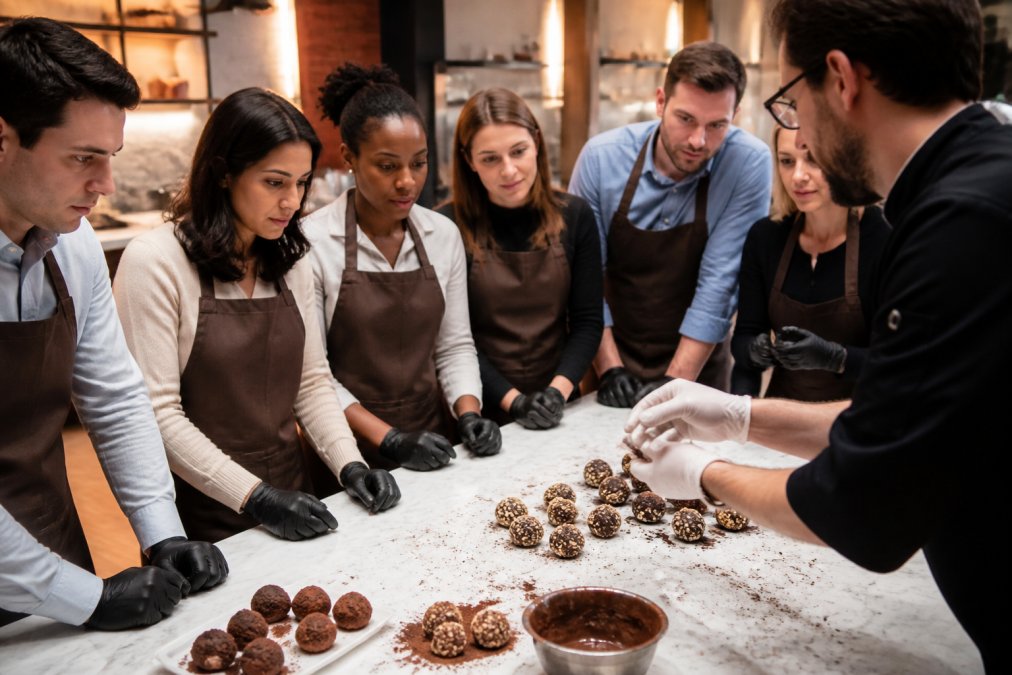
International Chocolate Events specialises in bespoke chocolate-making experiences tailored to your group size and objectives. Our master chocolatier brings over a decade of expertise, guiding teams through the entire process from cocoa selection to final plating. For corporate groups, this means flexibility: whether you’re hosting 15 people or 100+, the workshop scales without losing the personal touch that makes it memorable.
What makes this work as team building? The activity demands focus, people can’t multitask their way through tempering chocolate. There’s built-in problem-solving: “Why isn’t my ganache setting?” becomes a collaborative puzzle. The end result is tangible and shareable, giving teams something concrete to show for their time together.
The workshop typically runs 90 minutes to 2 hours, depending on your group’s pace (apa.org). Smaller groups (15-20 people) allow for more individual attention. Larger groups benefit from team-based stations where colleagues work in smaller units, then reconvene to share their creations.
The most successful chocolate workshops include a tasting element at the end. When teams taste what they’ve created alongside professionally made comparisons, the learning becomes tangible and the achievement feels real.
Dietary requirements are straightforward to accommodate: vegan chocolate options, nut-free environments, and gluten-free components can all be integrated without compromising the experience. International Chocolate Events works with your team to map out requirements in advance, ensuring every participant feels included.
Indoor Team Building Activities for Large Groups
When planning interactive team building activities for 40, 60, or 100+ employees, indoor venues offer climate control and logistical simplicity. The best indoor activities break participants into smaller teams, create friendly competition or collaboration, and provide clear feedback on progress.
Escape Rooms and Puzzle Challenges
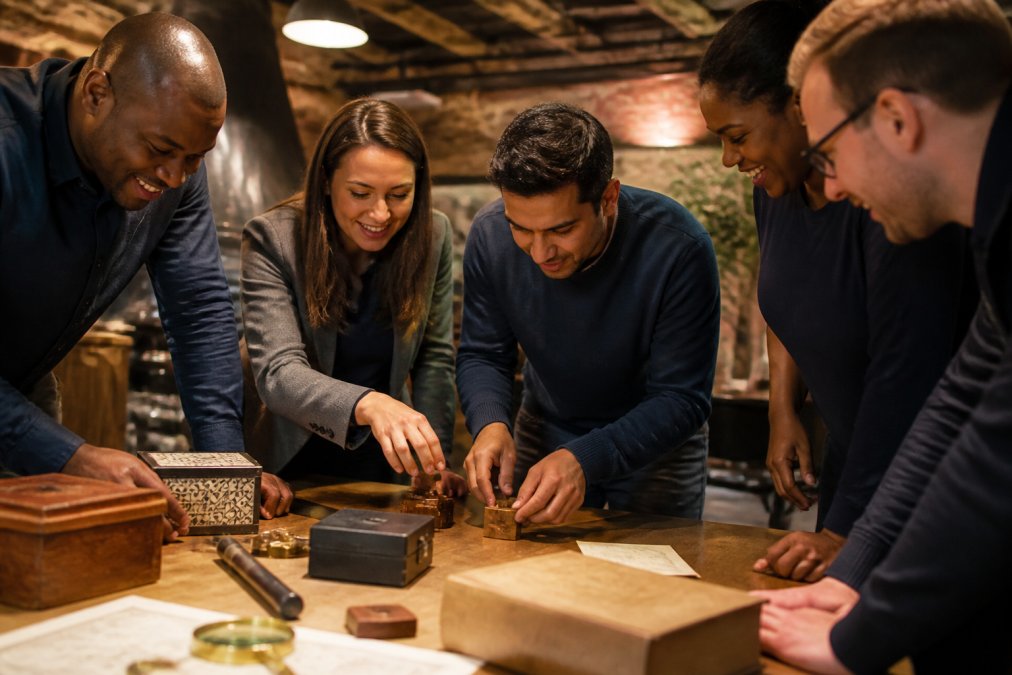
Escape rooms represent a specific type of interactive team building activity that works exceptionally well for medium to large groups. Teams have 60 minutes to solve puzzles and escape a locked room (peer-reviewed research). A well-designed escape room forces specialisation and interdependence, no single person can solve it alone; success requires genuine collaboration.
For groups larger than 12-15 people, run parallel rooms, staggering teams so they move through simultaneously. This keeps energy high and prevents bottlenecks. Most venues offer themed scenarios (detective, heist, survival) that add narrative depth.
Budget 60 minutes for puzzle-solving, plus 15-20 minutes for briefing and debrief. When coordinating multiple teams, add 30 minutes for transitions and regrouping.
Creative Workshops and Skill-Based Learning
Creative workshops, art classes, pottery, jewellery-making, or chocolate crafting, emphasise learning and creation rather than puzzle-solving. These work particularly well for groups that want to walk away with something tangible. Unlike a game where victory is the win itself, a creative workshop produces an artefact that extends the memory and impact well beyond the event day.
The pacing differs from competitive activities. There’s less time pressure, which can reduce anxiety for people who find high-pressure team games stressful. The focus shifts to experimentation, learning, and peer support. Quieter team members often become more engaged because the activity doesn’t reward speed or dominance, it rewards curiosity and effort.
For large groups, creative workshops require either multiple facilitators or a structured rotation system. International Chocolate Events manages this logistics automatically, ensuring every participant gets genuine hands-on time.
Outdoor Team Building Adventures
Outdoor activities shift the energy entirely. Whether it’s an orienteering challenge, a team relay, or outdoor cooking, outdoor team building adventures tap into different motivations: physical challenge, nature, fresh air, and often an element of mild adventure.
Outdoor activities naturally create memorable moments. An indoor game is forgotten by next week; an outdoor challenge where your team navigated a forest trail becomes a story people retell. This stickiness separates forgettable team building from genuinely impactful experiences.
Outdoor adventures scale well for large groups because you can run multiple challenges simultaneously across a larger space. A 100-person team can split into 10 teams of 10, each tackling different stations. The trade-off? Weather dependency. Rain, cold, or extreme heat can dampen enthusiasm. This is why outdoor activities work best in late spring through early autumn, and why having a weather contingency plan is essential.
Team Building Event Planning Tips for Success
Planning interactive team building activities at scale requires attention to details that seem minor until they go wrong. Start with clarity on objectives. Are you aiming to improve cross-departmental collaboration? Build trust after remote work? Celebrate a milestone? Different objectives call for different activities.
Next, map your constraints: budget, date flexibility, location accessibility, and dietary or mobility requirements. These aren’t peripheral details; they’re the foundation of a successful event.
Accessibility, Dietary Requirements, and Inclusive Design
Inclusive design means thinking through accessibility from the beginning, not as an afterthought. This includes physical accessibility (wheelchair access, lifts, accessible toilets), dietary accommodations (vegan, gluten-free, nut allergies, religious requirements), neurodivergent considerations (sensory-friendly options, quiet spaces, clear instructions), and activity modifications for varying fitness levels.
When booking interactive team building activities, ask the provider directly about their accessibility track record. Have they hosted groups with similar requirements? What specific accommodations can they provide? International Chocolate Events works with groups of all abilities by offering seated workshops, modifying physical demands, and ensuring dietary requirements are met without compromise.
Send a pre-event survey to participants asking about accessibility needs, dietary requirements, and concerns about the planned activity. Communicate these requirements clearly to your activity provider at least two weeks in advance.
Measuring ROI and Team Development Outcomes
Measuring ROI on team building is difficult because outcomes are often soft: improved morale, better collaboration, stronger relationships. But these have measurable proxies. Track metrics before and after: employee engagement scores, internal collaboration metrics, voluntary turnover rates, or sick leave usage.
Measure the event’s immediate impact through post-event surveys. Ask: “Did this activity help you understand your colleagues better?” “Would you recommend this activity to other teams?” “Did you learn something new?”
The activities that generate the strongest ROI are those where participants must genuinely collaborate to succeed, where the experience is novel enough to create memorable moments, and where the skills or relationships built have direct application back in the workplace.
Understanding Team Building Activity Duration and Scheduling
Duration matters more than people realise. A 90-minute activity feels rushed if the facilitator races through content. A 3-hour event with poor pacing feels interminable. The sweet spot depends on the activity type and your group’s expectations.
For interactive team building activities, consider these benchmarks:
| Activity Type | Typical Duration | Best For | Scheduling Notes |
|---|---|---|---|
| Chocolate-making workshop | 90-120 minutes | Groups 10-100+ | Works well as standalone or paired with lunch |
| Escape room | 60 minutes plus briefing | Groups 8-15 per room | Requires 15-20 min transition between groups |
| Creative workshop | 120-180 minutes | Groups 15-50 | Longer duration allows deeper skill development |
| Outdoor adventure | 120-240 minutes | Groups 20-100+ | Requires weather buffer, longer setup time |
| Competitive gaming tournament | 90-180 minutes | Groups 15-100+ | Scales well with multiple simultaneous matches |
A chocolate-making workshop for 15 people can run 90 minutes because everyone gets hands-on time. The same activity for 60 people needs 120 minutes minimum, or split into two sessions. Rushing defeats the purpose.
Scheduling matters strategically. A mid-week activity, particularly mid-morning when energy is highest, generates more genuine engagement than a Friday afternoon when people are mentally checked out.
Budget-Friendly and Premium Options for Every Group Size
Quality team building doesn’t require a massive budget. What matters is thoughtful selection and good execution, not expense.
For smaller groups (15-25 people), budget-friendly options include escape rooms, local creative workshops, or outdoor treasure hunts organised in-house.
For larger groups (40-100+), economies of scale help. A chocolate-making workshop for 100 people across two sessions costs less per head than the same activity for 20 people. Outdoor activities in public spaces cost far less than private venue hire.
The real cost isn’t always the activity itself, it’s logistics. Travel, catering, venue hire, and time away from work add up quickly. The most cost-effective team building activities often happen near the office, during normal working hours, with minimal additional logistics.
Premium options exist for organisations with larger budgets and specific objectives. International Chocolate Events offers bespoke experiences tailored to your exact group size, dietary requirements, and learning objectives. A premium chocolate-making workshop with a master chocolatier, custom packaging, and professional photography delivers a significantly more memorable and impactful experience.
The key question isn’t “How much should we spend?” but “What outcome do we want, and what’s the minimum investment needed to achieve it?”
Choosing interactive team building activities for your corporate group requires balancing genuine engagement, logistical feasibility, budget constraints, and inclusive design. The activities that work best are those where people must genuinely collaborate, where the experience is novel enough to create lasting memories, and where the outcome is tangible rather than abstract.
At International Chocolate Events, we specialise in creating bespoke chocolate-making experiences that tick all these boxes. Whether you’re planning an event for 20 people or 100+, our master chocolatier designs workshops tailored to your specific objectives, dietary requirements, and group dynamics. Make an enquiry with our team to discuss how a hands-on chocolate experience could transform your next corporate event.
Frequently Asked Questions
Q: Can interactive team building activities actually scale to 60+ people without feeling rushed?
A: Yes. Bespoke interactive team building activities can be structured in rotating groups or parallel sessions to maintain engagement at scale. A master chocolatier, for example, can facilitate multiple batches while maintaining personalized attention. The key is advance planning with your event organizer to ensure sufficient space, equipment, and facilitators. Venues with multiple rooms allow simultaneous workshops, so larger groups experience the same quality as smaller ones.
Q:
A: Interactive activities create lasting memories through hands-on collaboration and shared achievement. When team members work together toward a tangible outcome, like creating chocolate masterpieces or solving escape room puzzles, they build genuine connections beyond small talk. The experience becomes a reference point for future teamwork. Pairing the activity with post-event reflection or team photos reinforces the bonding effect and gives participants something concrete to take home.
Q: How do you handle dietary requirements and allergies in interactive team building activities?
A: Professional event organisers collect dietary information during registration and customise activities accordingly. For chocolate-making workshops, allergen-free alternatives, vegan chocolate, and gluten-free options are standard. Facilitators brief all participants on allergen protocols to ensure safety. Inclusive planning isn’t an add-on, it’s essential to ensure every team member can participate fully and feel valued, which strengthens overall team morale.
Q: What is the typical duration for interactive team building activities?
A: Most interactive team building activities last between 90 minutes and 3 hours, depending on complexity and group size. Chocolate-making workshops typically run 2-2.5 hours, allowing time for instruction, hands-on creation, and tasting. Escape rooms average 60 minutes. Longer events (half-day or full-day) can combine multiple activities with breaks and meals. Duration should balance engagement with schedules; too short feels rushed, too long risks fatigue.