
Table of Contents
- Defining Objectives Before Planning Corporate Events for Large Groups
- Corporate Event Budget Management: Allocating Spend Across 500+ Attendees
- Venue Sourcing, Logistics, and Risk Management
- Team Building Activities for Large Groups That Actually Stick
- Catering, Dietary Requirements, and Attendee Experience
- Corporate Event Health and Safety Regulations You Must Follow
- Your Corporate Event Planning Checklist: From Brief to Post-Event Survey
- Conclusion
Last Updated: August 27, 2026
Defining Objectives Before Planning Corporate Events for Large Groups
Planning corporate events for large groups fails most often in the brief, not execution. Without clear objectives, even polished events feel directionless and impossible to justify to stakeholders.
The first question is deceptively simple: what do you want people to feel, learn, or do differently? Team cohesion, leadership alignment, product launches, and employee recognition require fundamentally different formats. Trying to serve all simultaneously ensures none are served well.
Corporate event planning is the structured process of aligning a gathering’s format, activities, and logistics with defined business outcomes, attendee needs, and measurable performance indicators. That definition matters because it rules out planning backwards from a venue or activity you already like.
Setting Measurable Event KPIs
Event KPIs give you a basis for post-event evaluation and help justify future investment. Useful KPIs include attendee satisfaction scores, Net Promoter Score, knowledge retention rates for learning-focused events, and cross-team connection metrics from structured follow-up.
Set your KPIs before booking the venue. They shape every subsequent decision, from breakout session format to registration process design.
Hybrid and Remote-Inclusive Event Planning
Hybrid event planning has moved from pandemic workaround to genuine strategic choice. For distributed teams, excluding remote employees is no longer defensible.
Hybrid events require separate production thinking: a remote audience needs dedicated facilitation, not just a camera pointed at the stage. Assign a specific team member to manage the digital stream, moderate questions, and ensure real-time engagement. Event technology platforms supporting live polling, Q&A, and virtual breakout rooms are now standard expectations.
Corporate Event Budget Management: Allocating Spend Across 500+ Attendees
Budget allocation is where good intentions meet hard constraints. Costs do not scale linearly, doubling headcount rarely doubles costs, but often introduces entirely new cost categories.
Divide spend into fixed costs (venue hire, AV production, speaker fees, event management) and variable costs (catering per head, materials, transport). Fixed costs are your floor; variable costs balloon with headcount.
According to CIPD’s guidance on employee engagement investment, organisations that invest deliberately in employee experience see measurable improvements in retention and engagement. Frame budget decisions through this lens, not as pure cost.
Where Costs Escalate at Scale
Areas that catch coordinators off guard above 200 attendees:
- AV production: Single-screen setups fail for 500 people. Larger rooms require distributed speaker systems, multiple screens, and dedicated technicians.
- Catering services: Dietary requirements multiply at scale. Managing allergens, service timing, and menu variety requires professional coordination.
- Event security: Larger gatherings trigger different duty-of-care obligations. Security staffing, crowd management, and emergency egress planning increase in complexity.
- Event registration: Manual sign-in collapses above threshold. Dedicated event technology for registration, badge printing, and session allocation becomes necessary.
- Vendor management: Supplier numbers, contracts, and coordination touchpoints grow significantly. Budget for a dedicated event coordinator.
Sustainability and Carbon Footprint Tracking
Sustainability is no longer optional for corporate events. Many organisations have board-level carbon reduction commitments, and events are a visible test.
Practical steps include consolidating travel via rail-accessible venues, choosing seasonal and locally sourced catering, eliminating single-use plastic, and selecting venues with environmental accreditations. The BS 8901 sustainability standard for events, now superseded by ISO 20121 provides a recognised framework that procurement and ESG teams recognise.
Venue Sourcing, Logistics, and Risk Management
Venue sourcing is not simply finding space for headcount. The venue defines tone, constrains catering and AV options, determines transport logistics, and carries risk profile.
Start with a detailed event brief before approaching venues. Specify minimum and maximum capacity, required room configurations, AV infrastructure, catering facilities, accessibility requirements, parking and transport links, and contractual flexibility needed.
Scalability Challenges for 500+ Attendees
Events above 500 attendees represent a qualitatively different challenge, not just a larger version of smaller events. The attendee experience becomes harder to control, and the gap between well-run and chaotic widens considerably.
Specific challenges include:
- Crowd flow: Session transitions, lunch queues, and registration bottlenecks require active management. Map every attendee movement and identify pinch points.
- Breakout sessions: Splitting 500+ people requires careful pre-assignment, clear signage, and enough facilitators to maintain quality across all rooms.
- Communication: Attendees need real-time information. A dedicated event app or SMS system prevents chaos.
- Staffing ratios: Increase your event staff-to-attendee ratio as headcount grows. What works at 1:50 becomes inadequate at scale.
Contingency Planning and Event Security
Risk management addresses: venue failure, key speaker cancellation, severe weather, medical emergencies, and data breaches. Each scenario needs a named owner, decision trigger, and pre-agreed response.
Event security requirements depend on size, location, and profile. The Health and Safety Executive guidance on managing crowds safely provides the framework for risk assessment, crowd management, and emergency procedures under the Health and Safety at Work Act 1974.
Failing to conduct a formal risk assessment for a large corporate event creates direct legal exposure for the organising company and named coordinator. Document every assessment and keep records.
Team Building Activities for Large Groups That Actually Stick
The biggest mistake in corporate team building is confusing activity with outcome. A team that spends two hours together has not automatically built trust or improved communication. The activity must be designed to produce those outcomes.
What separates forgettable team building from effective experiences comes down to three factors: active participation, shared challenge, and a debrief connecting the experience to real working life.
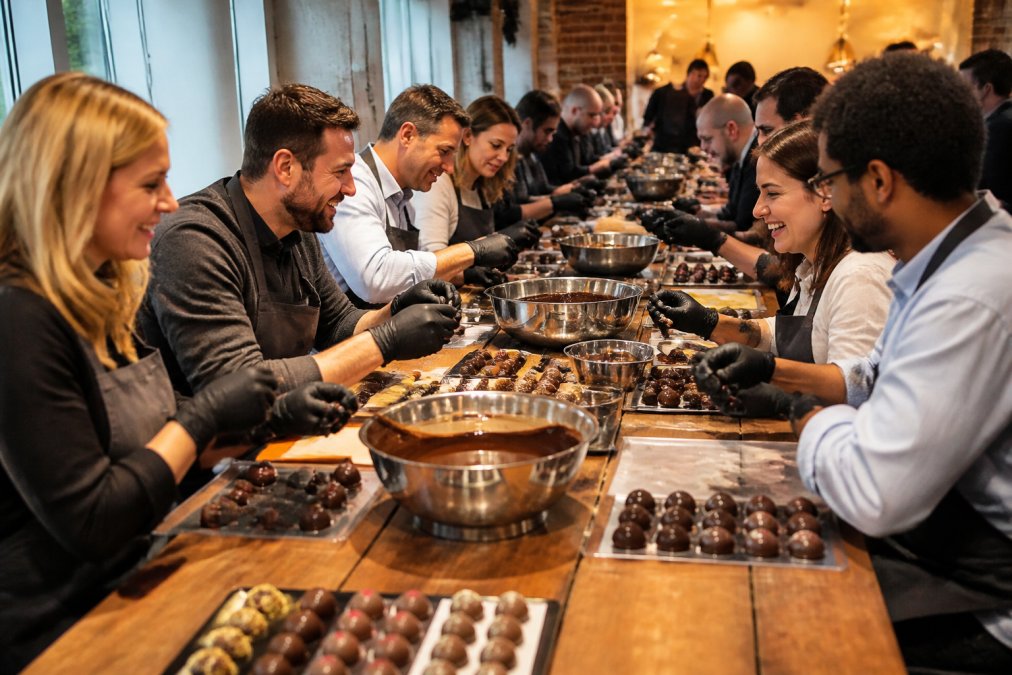
International Chocolate Events designs workshops around these principles. A hands-on chocolate-making session puts every participant on equal footing regardless of seniority, requires genuine collaboration, and generates shared reference points teams discuss weeks later. For groups of 15 to 100+, the scalable format ensures the experience remains personal and high-quality.
Hands-On Experiences vs Passive Sessions
Evidence for hands-on learning over passive instruction is well established. Passive formats produce almost no lasting behaviour change when used in isolation. They work as scene-setters, not main events.
Hands-on experiences work because they require real-time decision-making, problem-solving, and interdependence. The best team building activities for large groups share these characteristics:
- Low floor, high ceiling: Easy enough for everyone, complex enough to challenge
- Visible output: Participants create something tangible
- Natural conversation: The activity generates organic interaction
- Scalable facilitation: Quality holds across 20 or 200 participants
When briefing a team building provider, ask how they maintain experience quality as group size increases. The answer reveals whether their format genuinely scales or simply crowds more people into a small-group activity.
Catering, Dietary Requirements, and Attendee Experience
Catering is consistently underestimated in large-scale event planning. Above 50 attendees, informal approaches create real risk: missed allergens, inadequate provision for dietary requirements, and reputational damage.
Collect dietary requirements through event registration, not afterwards. Ask for allergen information specifically (the 14 major allergens under UK Food Standards Agency allergen guidance are minimum), plus vegan, vegetarian, halal, and kosher requirements.

For food-based activities like chocolate-making workshops, allergen management becomes part of experience design. At International Chocolate Events, dietary customisation is built into the workshop format, so guests with nut allergies, vegan requirements, or gluten-free needs are accommodated without being singled out.
Service timing, queue management, table layout, and food presentation all contribute to event feel. A poorly managed lunch break can undo goodwill from an excellent morning.
Corporate Event Health and Safety Regulations You Must Follow
Corporate event health and safety regulations are not specialist topics, they are core planning elements the organiser is legally responsible for, whether held in-house or outsourced.
The primary framework is the Health and Safety at Work Act 1974, which places duty on employers to ensure health, safety, and welfare at work-related events. The Management of Health and Safety at Work Regulations 1999 require written risk assessment for any event posing foreseeable risks.
Specific obligations for large corporate events include:
- Fire safety: Compliance with the Regulatory Reform (Fire Safety) Order 2005, including adequate exits, fire marshals, and evacuation procedures
- First aid provision: Sufficient trained first aiders per HSE guidance
- Food safety: Catering must comply with the Food Safety Act 1990, with allergen information provided in writing
- Accessibility: Events must meet Equality Act 2010 requirements, ensuring reasonable adjustments for attendees with disabilities
- Data protection: Registration data must comply with UK GDPR under the Data Protection Act 2018
Documenting compliance is as important as achieving it. Keep records of risk assessments, food safety certifications, and accessibility provisions.
Your Corporate Event Planning Checklist: From Brief to Post-Event Survey
A corporate event planning checklist is the operational backbone of large-scale events.
| Phase | Key Actions | Timing |
|---|---|---|
| Brief and objectives | Define KPIs, set budget, confirm headcount | 12+ weeks out |
| Venue sourcing | Issue RFP, site visits, contract sign-off | 10-12 weeks out |
| Supplier selection | Catering, AV, activities, transport | 8-10 weeks out |
| Attendee communication | Save the date, registration, dietary collection | 6-8 weeks out |
| Logistics confirmation | Run of show, staffing plan, risk assessment | 3-4 weeks out |
| On-site management | Registration, session flow, contingency activation | Event day |
| Post-event evaluation | Survey distribution, KPI review, debrief | Within 1 week |
Event Timeline and Stakeholder Communication
An event timeline keeps every supplier, internal stakeholder, and on-site team aligned. The most common failure is communicative, not logistical. Suppliers make assumptions, teams have conflicting information, and on-site decisions get made without authority.
Stakeholder communication should follow a structured cadence:
- Brief confirmation: Circulate agreed event brief to internal stakeholders for sign-off before supplier engagement
- Supplier briefing calls: Hold individual calls with each key supplier to confirm requirements and dependencies
- Progress updates: Weekly written updates to stakeholders from eight weeks out
- Final run-of-show: Distribute minute-by-minute timeline to all parties no later than 72 hours before the event
- Post-event survey: Deploy attendee feedback within 24 hours while impressions are fresh
Review event KPIs against post-event survey results within one week. Share findings with senior stakeholders promptly, this builds the case for continued investment and secures future budget.
The post-event survey is not administrative formality. It is your primary evidence base for demonstrating ROI, justifying spend, and improving the next event. A response rate above 40% is achievable when the survey is short, sent promptly, and clearly linked to visible changes.
Planning corporate events for large groups at scale demands rigorous attention to objectives, budget, logistics, and compliance. The activity you choose sits at the heart of whether attendees remember the day or forget it by Monday. International Chocolate Events delivers bespoke, hands-on chocolate-making workshops for groups from 10 to 100+, with dietary customisation, scalable facilitation, and shared experiences that generate genuine team connection. Make an enquiry to discuss your next event.
Frequently Asked Questions
How do you manage logistics for large-scale corporate events?
Start with a detailed event brief that covers attendee numbers, venue access, AV production needs, catering requirements, and transportation. Assign a dedicated event coordinator for each workstream, venue, suppliers, and attendee communication. Build buffer time into your event timeline for setup and breakdown. For groups above 200, consider a phased arrival schedule and breakout sessions to avoid bottlenecks. Vendor management and real-time communication tools are essential to keep all parties aligned on the day.
What are the most effective team building activities for large groups?
The most effective activities combine participation, creativity, and a shared outcome. Hands-on workshops, such as chocolate-making, cookery challenges, or craft-based sessions, consistently outperform passive presentations because every attendee contributes. For groups of 40 to 100+, structured breakout sessions allow smaller teams to work together before reconvening, which improves engagement across the whole group. Activities that produce a physical result guests can take home tend to generate stronger post-event recall and positive sentiment.
How do you ensure health and safety compliance for large corporate gatherings?
Under the Health and Safety at Work etc. Act 1974, event organisers have a duty of care to all attendees. For large gatherings, this means completing a formal risk assessment, appointing a competent first-aider, confirming venue compliance with fire safety regulations under the Regulatory Reform (Fire Safety) Order 2005, and checking that all suppliers hold valid public liability insurance. Food-based activities must also comply with UK Food Information Regulations regarding allergen labelling and disclosure.
What are the key stages of the corporate event planning process?
The core stages are: define objectives and set measurable KPIs; establish your budget and allocate spend by category; source and confirm your venue; build a detailed event timeline; brief all vendors and confirm logistics; manage attendee registration and communication; execute the event with on-site coordination; then close with a post-event survey to measure ROI. For large groups, each stage takes longer than expected, allow at least three months of lead time for events of 100 or more attendees.
How do you choose the right venue for a large corporate event?
Prioritise capacity, accessibility, and technical infrastructure. The venue must comfortably accommodate your full attendee count across both plenary and breakout sessions without feeling cramped. Check that AV production facilities, catering kitchens, and loading access meet your event's needs. Confirm transport links and parking for your group size. For interactive workshops, also verify that floor space and power supply can support the activity, a hands-on chocolate-making session, for example, requires adequate worktop space and ventilation.
What are some fun activities for corporate events?
Interactive culinary workshops are consistently rated among the most memorable corporate event activities because they are social, skill-based, and produce a tangible result. Chocolate-making workshops, in particular, work across a wide range of group sizes and require no prior experience. Other popular options include cocktail masterclasses, escape room challenges, and creative craft sessions. The best activities share one trait: every participant is actively involved rather than watching from the sidelines.
This article was written using GrandRanker