
Last Updated: November 5, 2026
Quick Summary
Integrating culinary challenges into corporate retreats gives attendees a shared, hands-on task that builds communication faster than a seated dinner. Start with your retreat goal, size the format to your group, fit it into a natural energy dip in the schedule, and budget it in fixed, variable and hidden costs.
- Culinary challenges give small teams a clear task and a visible result, which builds connection faster than a seated dinner.
- Define what should change after the retreat before choosing any challenge format.
- Standard challenges run around 90 minutes to 2 hours, and extended versions take half a day.
- Sort budget lines into fixed, variable and hidden costs, and model scenarios at 20% lower and higher attendance.
- Collect dietary and accessibility needs early and design separate, labelled stations so no one is sidelined.
Table of Contents
- Why Culinary Challenges Work Better Than Evening Dinners at Retreats
- Designing a Culinary Challenge Around Your Retreat Goals
- Corporate Team Building Cooking Activities That Suit Different Group Sizes
- Team Building Activity Duration: Fitting the Challenge into the Retreat Schedule
- Corporate Event Budget Planning for a Culinary Challenge
- Handling Dietary Needs, Allergies and Accessibility Without Diluting the Experience
- Booking Your Culinary Challenge: Requesting a Quote for Your Retreat
- Frequently Asked Questions
Corporate retreats often end with a long dinner where half the room is checking their phones by dessert. Integrating culinary challenges into corporate retreats gives your attendees something to do with their hands, their heads and each other. This planner’s guide explains how to design one, size it for your group, fit it into your schedule and budget it properly.
Why Culinary Challenges Work Better Than Evening Dinners at Retreats
A culinary challenge puts people to work in small teams, with a clear task and a visible result. A dinner asks them to sit still and make conversation. Most of the value of a retreat comes from people working together, and a shared task builds that faster than a seating plan does.
Here is what a well-run culinary challenge tends to do:
- Gets people talking across departments who rarely meet
- Creates a shared story the team refers back to for months
- Gives quieter staff a role that does not depend on speaking first
The aim is not to replace the dinner. It is to make the retreat feel active rather than something people sit through.
Designing a Culinary Challenge Around Your Retreat Goals
Start with the goal, not the chocolate. A challenge built to improve communication looks different from one built to reward a sales team or welcome new hires.
Ask three questions before you book anything:
- What should people do differently after the retreat?
- Which teams need to work together more?
- What does success look like in a month’s time?
Once you have answers, pick a challenge format that serves them. A timed team build rewards coordination. A recipe-creation task rewards creativity and debate. Keep the link between the activity and the goal clear enough that you can explain it to leadership in one sentence.
Corporate Team Building Cooking Activities That Suit Different Group Sizes
Not every format fits every room. Pick the format that matches how many people you have and how much space you can use.
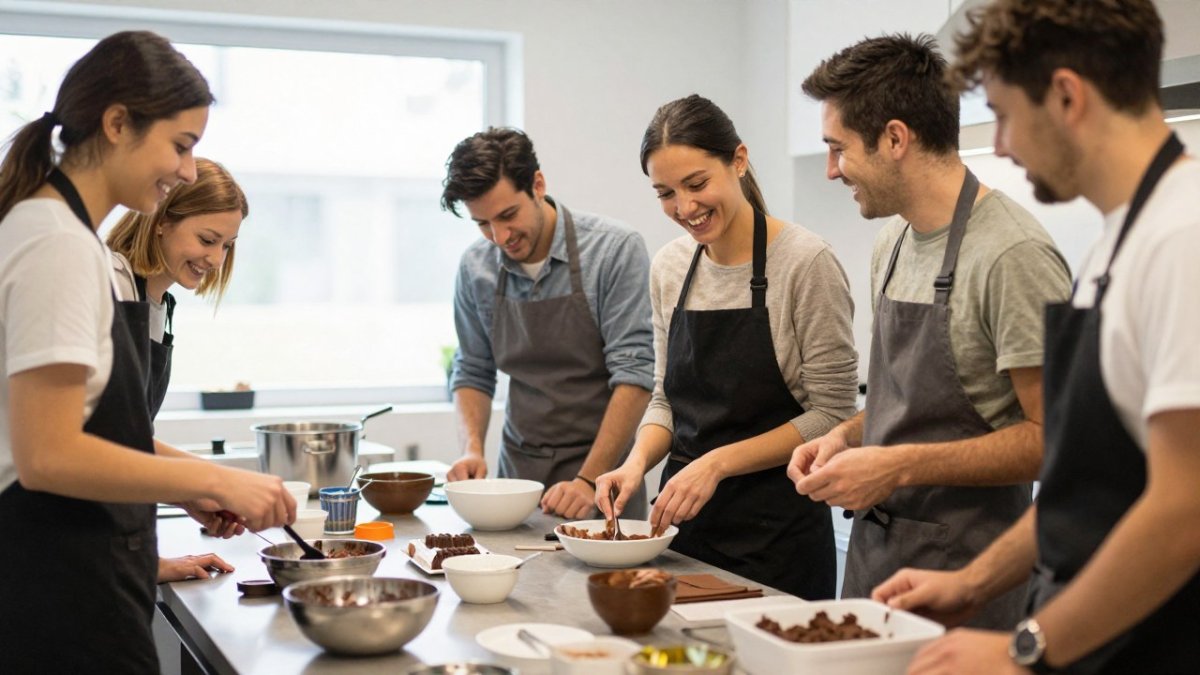
- Small groups (around 15 people): one shared bench, with each person having a defined role
- Mid-sized groups (around 40 people): several teams competing at separate stations
- Large groups (60 to 100+ people): staggered sessions or a hybrid of demonstration and hands-on work
Small and large scale events both work well for corporate team building, networking and social occasions. Our Truffle Express workshop is one ready-made option for groups of different sizes, and you can read more in our planning corporate events for large groups guide.
Sizing the Activity for 15 Versus 60 or 100 Attendees
Scale changes the experience more than most planners expect. A group of 15 can all work at one bench and talk to everyone. At 60 or 100, people need more stations, more facilitation and a clear structure so the room does not become chaotic.
For larger groups, plan for more facilitators per team, split the room into zones, and build in short moments where everyone regroups. Our guide to scaling interactive workshops for 100 guests covers this in more detail.
Team Building Activity Duration: Fitting the Challenge into the Retreat Schedule
Timing matters as much as format. A challenge that runs too long eats into the rest of the programme, and one that runs too short feels rushed.
Most planners find these durations work well:
- Short activity (around 60 minutes): a quick warm-up or energy break
- Standard activity (around 90 minutes to 2 hours): a full challenge with a clear finish
- Extended activity (half a day): a deeper project with reflection built in
Place the challenge where energy naturally dips, such as after a morning of sessions or before an evening event. Avoid putting it straight after a long presentation, when people are least ready to move.
Corporate Event Budget Planning for a Culinary Challenge
Budget is usually the first question leadership asks. Pricing depends on quantity, dates and delivery, so please make an enquiry with your group size and dates to request a quote.
What you can do before any quote arrives is build the budget structure yourself, so the quote drops into a framework rather than arriving as a single unexplained number. A common pattern among event planners is to split the culinary challenge budget into four lines: the activity itself, the space and equipment, travel and logistics, and contingency.
Fixed, variable and hidden costs
Most practitioners find it helps to sort every line into one of three buckets:
- Fixed costs do not change with attendance: facilitator day rates, equipment hire, transport of materials, and any venue hire minimum spend. These are the lines to lock down first because they set your floor.
- Variable costs scale per person: ingredients, aprons, consumables, and often the catering element if the challenge ends in a shared meal. These are the lines to model at 20, 40 and 80 attendees before you commit.
- Hidden costs are the ones that blow a budget quietly: delivery and collection outside normal hours, waste disposal, additional facilitators for large groups, corkage or service charges if the venue supplies food and drink, and the staff time to run a pre-event dietary and accessibility collection. Ask every supplier what is excluded, not just what is included.
Sample cost structure per head for groups of 20, 40 and 80
The table below shows the categories to plan for and the questions to ask suppliers. It is a structure, not a price list.
| Cost category | Group of 20 | Group of 40 | Group of 80 | What to ask the supplier |
|---|---|---|---|---|
| Activity and facilitation | Higher per head | Mid per head | Lowest per head | Is the facilitator rate per session or per head? How many facilitators per team at each size? |
| Ingredients and consumables | Per head | Per head | Per head, often with a bulk discount | Is there a minimum order? What is the wastage policy? |
| Space and equipment | Venue dependent | Venue dependent | Venue dependent, often higher for multiple stations | Does the venue charge per room, per hour or per station? Is setup and breakdown included? |
| Travel and logistics | Location dependent | Location dependent | Location dependent | Is delivery, collection and out-of-hours access charged separately? |
| Contingency | 10-15% | 10-15% | 10-15% | , |
Connecting the budget to revenue and break-even
If the retreat is funded partly by ticket sales, sponsorship or departmental chargebacks, the culinary challenge budget should be modelled against that income rather than in isolation. A simple approach is to calculate cost per attendee for the challenge, then compare it with the per-attendee contribution from tickets or sponsorship. If the challenge costs more per head than the event earns per head, either the format needs to shrink or the funding line needs to grow, and it is far easier to have that conversation before the quote is signed than after.
Scenario planning before you commit
Model at least three scenarios before you approve the budget: attendance at your target number, attendance 20% lower, and attendance 20% higher. The lower scenario shows you the fixed-cost floor you cannot escape; the higher scenario shows where variable costs and facilitator ratios break. If your retreat is booked across regions, also model a supplier price change of a few percent between quote and delivery, because that is the most common reason a signed budget drifts.
Post-event reconciliation
Close the budget properly after the event. Compare actual spend against forecast line by line, calculate cost per attendee and note where the variance came from. That record is what makes the next retreat’s budget faster and more accurate, and it gives you a defensible answer when leadership asks why the challenge cost what it did.
Handling Dietary Needs, Allergies and Accessibility Without Diluting the Experience
Dietary needs are a planning task, not a reason to cut the activity back. Collect requirements well before the event. The gap most planners fall into is treating these as a last-minute checklist rather than as design and budget inputs, and that is where both the experience and the cost estimate go wrong.
Collecting requirements early enough to matter
Ask attendees at registration, not on the day, and ask specifically rather than with a free-text box that produces unusable answers. A short form that captures allergies, dietary preferences, mobility and access needs, and any requirement for a quieter or lower-sensory station gives you something you can actually plan against. Set a cut-off date, most practitioners find two to three weeks before the event works, and confirm the final list with the provider in writing.
Designing the challenge so nobody is sidelined
A culinary challenge can stay the same for everyone if the design accounts for difference from the start. Practical mechanisms include:
- Separate, clearly labelled workstations for allergen-free ingredients, with their own utensils and boards, so a nut allergy is managed by layout rather than by asking someone to opt out.
- A role for every station that does not depend on handling a specific ingredient, measuring, timing, plating, presenting, so a dietary restriction never means sitting out.
- Accessible station heights and clear circulation space between benches, planned before the room is laid out rather than after.
Making dietary and accessibility costs visible in the budget
These are planned budget lines, not afterthoughts. Ask the provider what they can accommodate and what it would cost before the quote is finalised. Build them into the activity line rather than the contingency, so the buffer stays available for genuine changes.
Sustainable procurement as a budget line
Ask the provider what is included as standard and record the answer alongside the rest of the quote so the trade-off is visible to whoever approves the spend.
Our team can talk you through what is possible for your group when you make an enquiry.
Booking Your Culinary Challenge: Requesting a Quote for Your Retreat
Bring together your goal, group size, dates and budget, and send them through. A clear brief gets a faster, more accurate quote.
If your retreat is abroad or across several regions, check whether bespoke team events can run at your location. Our global events page explains what is available, and you can also reach out directly through our contact page for a quote tailored to your retreat.
Frequently Asked Questions
How do culinary challenges improve team collaboration?
Culinary challenges give colleagues a shared, time-limited task with visible results, so they must divide roles, communicate and adjust quickly. Unlike a seminar, everyone has a hands-on part to play, which lowers the hierarchy that often shapes office conversations. Teams usually finish with a concrete outcome they can discuss, which gives the session a clear point of reference when people return to work and makes the collaboration easier to recall.
What are the benefits of hands-on cooking activities for corporate groups?
Hands-on cooking activities keep attendees physically and mentally engaged, which helps sustain attention during a long retreat day. They suit mixed groups because skill levels matter less than participation, and they create informal conversation between departments that rarely work together. Many planners also value that the activity is easy to tailor to a brief, whether the goal is energy, collaboration or celebration.
What is the average cost per head for a corporate culinary workshop?
International Chocolate Events has not published fixed prices, and cost per head depends on group size, session length, dates and delivery location. For a current figure for your group, request a quote through our enquiry form, giving your headcount, preferred duration and whether you need travel to your venue. Budget guidance for the wider retreat is covered in the budget section of this guide.
How can chocolate-making workshops be integrated into a professional retreat?
The most effective approach is to place the workshop where it supports the retreat’s purpose, such as a mid-afternoon session that breaks up presentations or a shared evening activity after a strategy day. Agree on the team objective first, then design the challenge around it. Confirm the timing with your facilitator so the workshop fits the programme rather than competing with it.
