
Table of Contents
- What Makes Hands-On Culinary Entertainment Work for Retreats
- 1. Chocolate-Making Workshops: Interactive Indulgence
- 2. Farm-to-Table Cooking Classes: Seasonal Skill Building
- 3. Wood-Fired and Traditional Cooking Techniques
- Corporate Team Building Cooking Classes: What Sets Them Apart
- Team Building Activity Duration: Planning the Right Length
- How to Plan a Corporate Culinary Event: Key Logistics and Considerations
- Quick Comparison: Culinary Entertainment Options at a Glance
- Frequently Asked Questions
Last Updated: September 2, 2026
What Makes Hands-On Culinary Entertainment Work for Retreats
Hands-on culinary entertainment transforms a standard team event into a memorable, bonding experience. When people make something with their own hands, they’re building shared accomplishment, lowering social barriers between colleagues, and creating a tangible takeaway that extends beyond the event itself. Research shows experiential activities generate stronger team cohesion than lectures or passive entertainment, and culinary experiences rank among the highest for engagement and recall (peer-reviewed research).
At International Chocolate Events, we’ve designed hands-on culinary entertainment specifically for corporate retreats and social celebrations. Our master chocolatier brings over a decade of experience crafting bespoke workshops that scale from intimate groups of 10 to large corporate events of 100+ participants. The key is balancing structure with flexibility, providing enough guidance that everyone succeeds while allowing creativity to flow.
Below, we’ll explore seven proven formats for hands-on culinary entertainment, from chocolate-making workshops to farm-to-table cooking classes, along with the logistics that make these experiences work at scale.
1. Chocolate-Making Workshops: Interactive Indulgence
A chocolate-making workshop sits at the intersection of indulgence and skill-building. Participants learn the fundamentals of tempering, moulding, and flavour pairing while creating products they can taste and take home immediately. This tangibility transforms the experience from “we did an activity” to “we made something worth keeping.”
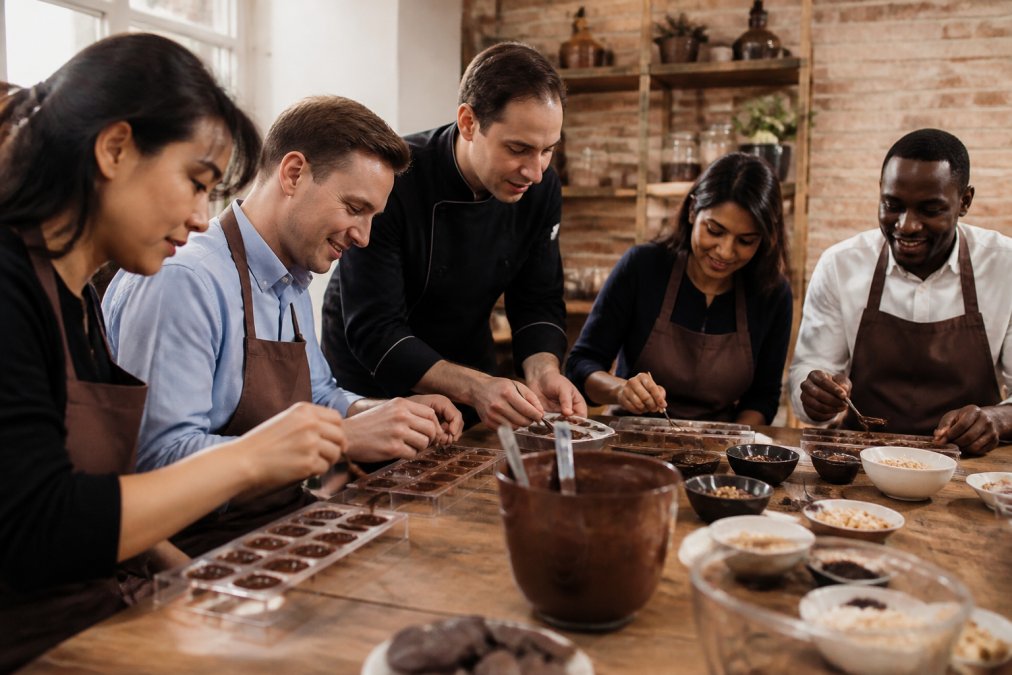
The workshop format works across skill levels. Beginners learn chocolate handling and tempering basics. Intermediate participants explore flavour combinations and decoration techniques. Advanced groups dive into ganache-making or single-origin chocolate work. This flexibility means mixed groups can all participate meaningfully.
Chocolate-making workshops generate the highest “take-home” value of any culinary activity. Participants leave with finished truffles, pralines, or bars they’ve created themselves. This physical reminder extends engagement long after the retreat ends, making it one of the strongest retention tools for team-building impact.
The typical workshop runs 90 minutes to 2 hours and accommodates groups from 10 to 50+ participants when structured with stations. International Chocolate Events designs these workshops to work in any venue, hotel ballrooms, corporate offices, or retreat centres, with minimal equipment requirements. The experience combines education, sensory pleasure, and team building as people naturally cluster around chocolate-working stations, chat while waiting for chocolate to set, and compare their creations. The activity breaks down hierarchy; executives and junior staff are equally uncertain about tempering, equally delighted when their truffle succeeds.
2. Farm-to-Table Cooking Classes: Seasonal Skill Building
Farm-to-table cooking classes anchor culinary entertainment in local ingredients and seasonal rhythms. Participants learn to cook a complete meal using produce sourced from regional growers, understanding where their food comes from and how to build menus around what’s in season.
This format appeals especially to retreats focused on sustainability, wellness, or cultural immersion. A spring class might feature asparagus and fresh herbs; autumn shifts to root vegetables and game. The educational component runs deeper than chocolate-making. Participants learn knife skills, heat management, flavour balancing, and plating technique.
Farm-to-table cooking classes work best for groups of 20-60 people when structured with multiple cooking stations and a professional kitchen or well-equipped venue. Smaller groups allow more one-on-one instruction; larger groups require careful station design to avoid bottlenecks.
The team-building dimension differs from chocolate workshops. Rather than individual creations, participants work in small teams on different courses. One team handles the starter, another the main, a third the dessert. This requires coordination and communication; someone must time the courses so they’re ready together. Farm-to-table classes typically run 3 to 4 hours, including cooking and a seated meal. They require access to a proper kitchen, which limits venue flexibility compared to chocolate workshops, but the depth of experience justifies the investment.
3. Wood-Fired and Traditional Cooking Techniques
Wood-fired ovens and open-flame cooking create a primal appeal that modern appliances can’t match. Whether baking sourdough in a wood-fired oven, roasting vegetables over flames, or slow-cooking meat in a clay pot, these traditional techniques carry cultural weight and generate genuine excitement.
Wood-fired cooking works particularly well for larger retreats and outdoor settings. The physical gathering around a fire creates natural social clustering. The slower pace of wood-fired cooking forces conversation and patience. A wood-fired retreat might feature pizza-making, where participants stretch dough and top their own pizzas before the instructor slides them into the oven. The sensory experience, the smell of wood smoke, the heat on your face, the visual spectacle of flames, creates a stronger emotional memory than indoor cooking.
The logistics are more demanding. You need outdoor space, weather contingency planning, proper ventilation, and trained staff managing the fire and ensuring food safety. But for groups seeking something genuinely different, wood-fired cooking delivers.
Corporate Team Building Cooking Classes: What Sets Them Apart
Corporate team-building cooking classes differ from recreational cooking classes in one fundamental way: they’re designed explicitly to strengthen working relationships and develop collaboration skills, not just to teach cooking.
A recreational cooking class focuses on the food. A corporate team-building class focuses on the team, using food as the vehicle. Effective corporate culinary team-building includes:
- Clear team assignments where different groups own different outcomes, forcing coordination across teams
- Timed challenges that create mild pressure and require quick decision-making under constraints
- Facilitated reflection where the instructor helps the group process what they learned about collaboration and communication
- Balanced participation where no single person can dominate; success requires everyone contributing
A well-designed corporate culinary event might assign teams to different cooking stations, each responsible for one course. As the event progresses, teams must communicate about timing, share equipment, and adapt to unexpected problems. The instructor observes and, at the end, guides a brief debrief: “Notice how Team A solved the timing problem? That’s the same problem-solving you need in project work.”
Corporate culinary events fail when treated as pure entertainment with no structure or reflection. If people just cook and eat without facilitation of the team-building element, the experience feels like a nice break but doesn’t shift team dynamics. Budget time for both the activity and the debrief.
Team Building Activity Duration: Planning the Right Length
How long should a hands-on culinary team-building activity be?
The answer depends on group size, activity complexity, and your broader retreat schedule.
For chocolate-making workshops: 90 minutes to 2 hours is optimal. This allows time for introduction and safety briefing (10 minutes), hands-on creation (60-80 minutes), and tasting or wrapping finished products (10-15 minutes).
For cooking classes: 2.5 to 4 hours. This includes setup and introduction (15 minutes), active cooking (90-150 minutes), plating and presentation (15-20 minutes), and eating together (20-30 minutes).
For wood-fired or open-flame cooking: 2 to 3.5 hours. The slower pace means less clock-watching, but three hours is the practical ceiling for standing around a fire.
For large group events (50+ people): Add 20-30 minutes for logistical overhead.
Build in 20-30 minutes of buffer time between culinary activities and other retreat programming. A 2-hour chocolate workshop followed immediately by a keynote speech means people are still cleaning chocolate off their hands during the keynote.
How to Plan a Corporate Culinary Event: Key Logistics and Considerations
Planning a hands-on culinary event for a corporate retreat requires attention to seven critical areas: venue, equipment, instructor expertise, dietary requirements, group size and pacing, catering logistics, and contingency planning.
Scaling for Large Groups (40-100+ Participants)
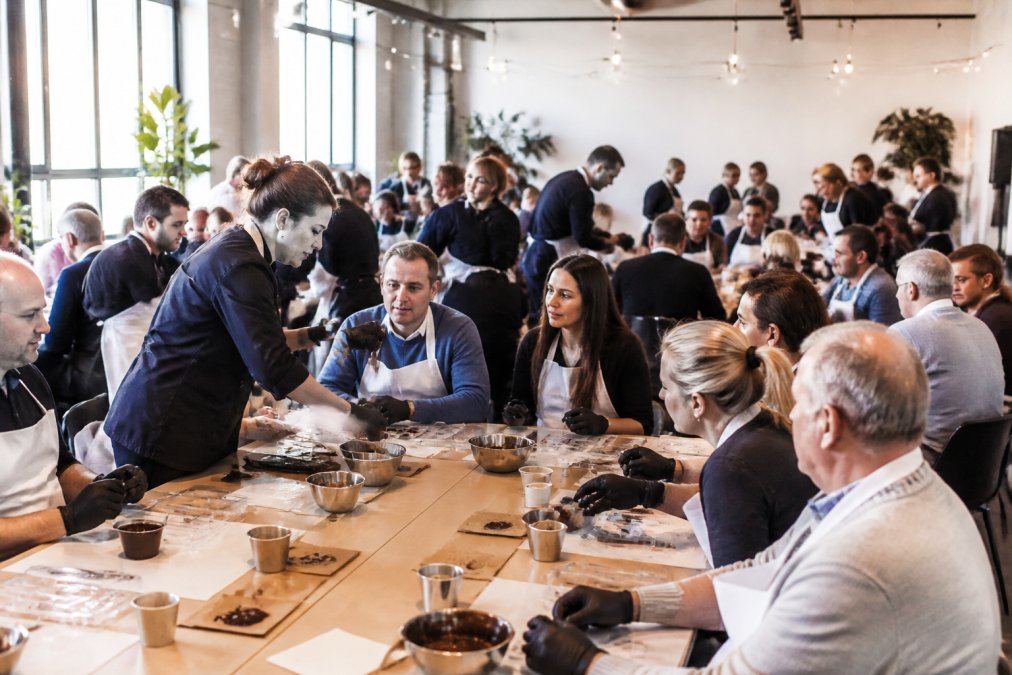
Large groups demand station-based design. Rather than one instructor teaching everyone simultaneously, you run multiple parallel stations, each with a trained facilitator and a small group (8-15 people). This prevents bottlenecks and keeps everyone actively engaged.
For chocolate-making at scale, you might run four simultaneous stations: tempering and moulding, decoration, flavour pairing, and packaging. Groups rotate through stations every 20-30 minutes.
The critical variable is instructor-to-participant ratio. For chocolate-making, one instructor can comfortably manage 12-15 people. For cooking, the ratio is tighter, one instructor per 8-10 people, because cooking involves more safety considerations and technique coaching. At 60 people, you need at least 5-6 trained facilitators.
International Chocolate Events scales workshops across all group sizes by pre-training facilitators, designing station workflows, and building in buffer time. The experience doesn’t feel rushed or impersonal at 80 people because the station-based design means participants spend most of their time in small, engaged groups.
Dietary Requirements and Customisation
Dietary requirements are non-negotiable. Your group almost certainly includes people with nut allergies, vegan preferences, gluten-free needs, or religious dietary restrictions. A poorly handled dietary requirement signals that your organisation didn’t care enough to plan properly.
For chocolate workshops, nut allergies are the primary concern. You need:
- Clear communication before the event asking about allergies and dietary preferences
- Separate, clearly labelled ingredients and equipment for nut-free participants
- A trained facilitator who understands cross-contamination risks
- Finished products stored separately so someone with a severe allergy isn’t exposed to airborne particles
For cooking classes, customisation runs deeper. Vegan participants need plant-based alternatives for butter, cream, or meat. Gluten-free attendees need different flour or pasta. Kosher or halal requirements might mean sourcing specific ingredients or using separate equipment.
Ask about dietary needs 3-4 weeks before the event, group participants with similar requirements, and ensure your instructors have tested recipes and techniques for each variation.
Location and Logistics
Venue choice determines what’s possible. A chocolate workshop can happen in a hotel ballroom, a corporate office, or a dedicated event space. You need:
- Tables sturdy enough for people to work standing
- Water access for cleaning up
- Electrical outlets for heating chocolate or equipment
- Climate control (chocolate melts if the room is too warm)
- Good lighting
Cooking classes demand more infrastructure: a proper kitchen or catering facility with commercial-grade cooktops, adequate counter space, proper ventilation, food-safe storage, and access to fresh water.
Wood-fired cooking requires outdoor space, weather contingency (a tent, at minimum), and proper fire safety setup.
International Chocolate Events works with clients to identify venues that meet these requirements or can be adapted. For corporate retreats at hotels or dedicated retreat centres, we’ve usually worked out the logistics beforehand. For bespoke locations, we conduct a site visit to assess what’s feasible and what adaptations are needed.
International Chocolate Events operates globally, bringing the experience to your chosen location. This flexibility is crucial for large corporate retreats where moving 60 people to a different venue isn’t practical.
Quick Comparison: Culinary Entertainment Options at a Glance
| Culinary Format | Duration | Ideal Group Size | Skill Level Required | Dietary Customisation | Best For |
|---|---|---|---|---|---|
| Chocolate-Making Workshops | 90 mins-2 hrs | 10-60+ | Beginner to advanced | Easy (nut-free options) | Quick team engagement, take-home products |
| Farm-to-Table Cooking | 3-4 hrs | 15-50 | Beginner to intermediate | Moderate (plant-based, gluten-free options) | Sustainability focus, deeper skill-building |
| Wood-Fired Cooking | 2-3.5 hrs | 15-80 | Beginner to intermediate | Moderate (fire safety limits some options) | Outdoor settings, memorable sensory experience |
| Corporate Team-Building Classes | 2-4 hrs | 10-100+ | Beginner to intermediate | Customisable | Explicit team development, facilitated reflection |
Hands-on culinary entertainment for retreats works because it combines three elements that most corporate events lack: active participation, immediate sensory reward, and a tangible takeaway. Whether you choose chocolate-making for its indulgence and quick impact, farm-to-table cooking for its educational depth, or wood-fired techniques for their primal appeal, the structure matters more than the specific format.
The best culinary team-building experiences are planned with the same rigour you’d apply to any business initiative. Clear objectives, proper logistics, and attention to inclusion separate memorable events from forgettable ones.
International Chocolate Events specialises in designing and delivering hands-on culinary entertainment that scales to your group size, accommodates dietary requirements, and generates genuine team connection. Whether you’re planning a 15-person departmental offsite or a 100-person company retreat, the experience is tailored to your specific needs and delivered by experienced facilitators who understand both the culinary craft and the team-building objectives. Make an enquiry to discuss your retreat vision and explore how hands-on culinary entertainment can transform your next corporate event.
Frequently Asked Questions
Q: Can hands-on culinary entertainment actually work for a group of 60+ people without feeling rushed?
A: Yes, when structured properly. The key is dividing large groups into smaller cooking stations (typically 8-12 per station) with dedicated instructors at each. Staggered timing, where groups rotate through stations, keeps the experience intimate despite the overall size. International Chocolate Events scales their setup to handle 60, 80, or even 100+ participants by using multiple kitchen areas, pre-prepped ingredients, and well-coordinated logistics. The experience remains hands-on and personal because each participant actively participates at their station rather than passively watching.
Q: What team building benefits do corporate team building cooking classes actually deliver?
A: Hands-on culinary activities build trust, communication, and collaboration in ways traditional team-building cannot. Teams must coordinate tasks, share responsibility for a finished dish, and solve problems together in real time. The shared meal at the end creates informal bonding that extends conversations beyond work. Unlike activities that feel forced, cooking classes feel rewarding because participants leave with a tangible accomplishment, food they created themselves, which strengthens memory retention of the team-building experience and translates to improved workplace relationships.
Q: How long should a team building activity be to maximise engagement without losing momentum?
A: Most effective culinary team building activities run 2-3 hours. This duration allows time for introduction, hands-on cooking (the core engagement), and a communal meal or tasting. Shorter sessions (under 90 minutes) feel rushed and don’t allow proper skill development or team interaction. Longer sessions (4+ hours) risk participant fatigue and dilute focus. A 2.5-hour workshop with a 30-minute introduction, 90 minutes of active cooking, and 30 minutes for tasting or plating strikes the right balance for corporate groups.
Q: What dietary restrictions can culinary retreat providers actually accommodate?
A: International Chocolate Events can accommodate nut allergies, vegan diets, gluten-free requirements, and other common restrictions, but customisation must be arranged in advance. We ask for dietary information when you book and adjust recipes, ingredients, and preparation accordingly. Chocolate workshops, for example, can use nut-free chocolate, dairy-free alternatives, and gluten-free biscuits. The key is communicating all dietary needs upfront and confirming our ability to deliver before committing.
Q: How do you know a culinary retreat experience will actually stick with your team after the event?
A: Retention depends on three factors: hands-on participation (passive watching doesn’t stick), takeaways participants can use at home (recipes, techniques, or a product they made), and a structured debrief that connects the experience to team goals. The most memorable culinary events give participants something tangible to take away, a box of chocolates they made, a recipe card, or photos from the event. Following up with a team reflection or sharing photos reinforces the memory. International Chocolate Events emphasises skill-building over entertainment, and tailors the experience to your team’s dynamics, to create longer-lasting impact.