
Last Updated: October 30, 2026
Quick Summary
The best culinary workshop themes for company retreats are pasta-making, bread-making, fermentation, plant-based and seasonal cooking, regional cuisine, patisserie and chocolate, street food, mystery-box challenges and cook-offs. Match the theme to your team goal, group size and dietary picture before you request quotes.
- Pasta workshops suit groups of 10 to 40 and scale with extra stations.
- Bread-making uses the proving window for a facilitated discussion or second activity.
- Plant-based menus make a session inclusive for vegan, vegetarian and many religious requirements at once.
- Score cook-offs on presentation, teamwork and creativity as well as taste so quieter teams stay in the game.
- Collect dietary requirements at registration, not the week before, and treat nut allergies as a hard constraint.
Table of Contents
- Why Culinary Workshop Themes Work for Company Retreats
- Cooking Team-Building Activities That Suit Every Group
- Pasta-Making and Dough Workshops
- Bread-Making and Baking Sessions
- Fermentation and Preserving Workshops
- Plant-Based and Seasonal Cooking
- Regional and International Cuisine Workshops
- Patisserie, Dessert and Chocolate Themes
- Street Food and Global Small Plates
- Mystery-Box and Ingredient-Challenge Formats
- Cook-Offs and Culinary Team Challenges
- No-Cook and Low-Equipment Alternatives
- The Chocolate-Making Team-Building Workshop
- Corporate Retreat Activities for Large Groups
- Food and Drink Planning for Company Retreats
- Matching Culinary Workshop Themes to Team Goals
- Planning Dietary Needs, Budget and Logistics
- Enquire About a Chocolate Workshop for Your Retreat
- Frequently Asked Questions
Why Culinary Workshop Themes Work for Company Retreats
The best culinary workshop themes do three jobs at once. They give quiet colleagues a role, they create a natural talking point, and they end in something everyone can taste.
That last part matters more than most planners expect. A workshop that finishes with a shared plate of food leaves a physical memory attached to the day. ACAS guidance on team effectiveness points out that well-designed shared activities help colleagues understand how they work together, which is exactly what a hands-on food session exposes.
Below, we break down the formats that work, how to match a theme to what your team actually needs, and what to sort out before you book anything.
Cooking Team-Building Activities That Suit Every Group
Cooking team-building activities work best when the format matches the group’s energy and size.
Below is a practical catalogue of the themes that recur across UK providers, with what each one is actually like to run. For a hands-on option that works for small and large groups, see the Truffle Express workshop.
Pasta-Making and Dough Workshops
A pasta workshop is a dough-handling session: teams mix, knead, rest and roll pasta, then shape tagliatelle, ravioli or filled parcels before it is cooked and eaten together.
The appeal is rhythm: kneading is calming, rolling is collaborative, and the finished plate arrives quickly, ideal for a team coming out of back-to-back meetings.
Bread-Making and Baking Sessions
Bread-making is a longer, slower format built around proving time. Teams mix, knead and shape dough, then use the proving window for a facilitated discussion or second activity before baking and eating.
Baking (cakes, biscuits, pastry) is the faster cousin and works well for celebration retreats because the output is shareable and photogenic.
Fermentation and Preserving Workshops
Fermentation sessions cover kimchi, sauerkraut, kombucha, pickles or sourdough starters. They are unusual, memorable and produce a take-home jar that keeps working after the retreat.
The practical catch is time: true fermentation happens over days, so the workshop is really about preparation and setting up a culture to take away.
Plant-Based and Seasonal Cooking
Plant-based workshops build a menu entirely from vegetables, pulses and grains, and are the easiest format to make inclusive for vegan, vegetarian and many religious dietary requirements in one go.
These themes suit teams with a strong sustainability agenda and are increasingly requested by UK organisers.
Regional and International Cuisine Workshops
Regional cuisine workshops take a group somewhere unfamiliar. A Thai cookery session, an Indian cooking class or an Asian street food menu gives people a shared learning curve and a story to tell.
These suit teams that already know each other well: the novelty of a new cuisine gives experienced colleagues something to be bad at together.
Patisserie, Dessert and Chocolate Themes
Patisserie and dessert sessions focus on precision: choux, tarts, ganache, tempering and decoration. They suit detail-oriented teams and produce a visually impressive result, making them strong for celebration retreats and client-facing groups.
The trade-off is that precision formats can frustrate groups who want a looser, more social session. If your team skews towards quick wins, choose a format with a faster visible result.
Street Food and Global Small Plates
Street food workshops split a group into small teams, each responsible for one dish or stall, then bring everything together as a shared spread.
This suits cross-departmental groups and larger headcounts, since multiple small stations keep everyone busy. It also handles dietary variety well, because individual stalls can be vegetarian, vegan or gluten-free without disrupting the whole menu.
Mystery-Box and Ingredient-Challenge Formats
A mystery-box challenge gives each team an identical sealed box of ingredients and a fixed time to produce a dish. It is the most problem-solving-heavy format and exposes planning, delegation and decision-making quickly.
It suits teams working on collaboration or leadership themes and surfaces how a group behaves under mild pressure.
Cook-Offs and Culinary Team Challenges
A cook-off splits the room into teams, hands each a box of ingredients and a time limit, and lets them compete. The format is simple, the stakes are low, and the debrief writes itself.
The trick is to avoid pure competition, teams that lose badly remember it.
A culinary team challenge also works as a problem-solving exercise.
Shortlist three themes, then check each against your group size, dietary picture and venue equipment before you request quotes. The theme that survives all three filters is usually the right one.
No-Cook and Low-Equipment Alternatives
Not every retreat has a kitchen. No-cook formats, chocolate truffle rolling, sushi rolling, dessert assembly, cocktail or mocktail making, and blended spice or seasoning workshops, need only tables, power and cold storage. They are the practical answer for hotel meeting rooms, hybrid retreats and venues without catering facilities.
The Chocolate-Making Team-Building Workshop
A chocolate-making team-building workshop is a guided session where colleagues temper, mould and hand-roll chocolate together, usually finishing with truffles or bars they take home.
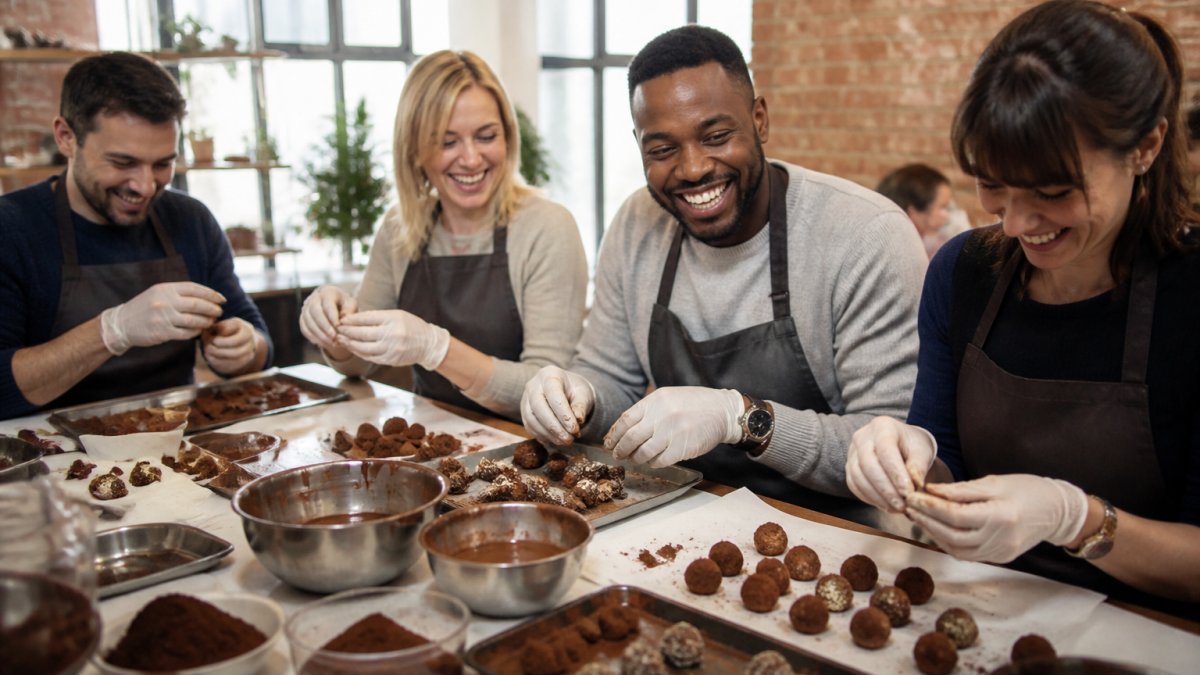
Our master chocolatier has over a decade of experience, and the format scales from 10 people to groups of 100 or more. Teams are bespoke to each event and can be arranged to suit the group.
A hands-on chocolate session gives colleagues a shared sensory experience to remember together. To see the full format, explore our chocolate team building events and how they run for different group sizes.
Best for: mixed-ability teams, celebration retreats and groups where a competitive format would feel forced.
Skip if: your team genuinely wants a hard competitive challenge with a leaderboard.
Corporate Retreat Activities for Large Groups
Corporate retreat activities for large groups fail when logistics overwhelm the experience.
The fix is station-based design. Split a large group into teams of 8 to 12, give each team its own station and facilitator, and rotate if space allows.
For big headcounts, our guidance on scaling interactive workshops for 100 guests covers room layout, staffing ratios and timing.
Food and Drink Planning for Company Retreats
Food and drink planning for company retreats is where most of the risk sits.
Start with the dietary picture before you choose a theme.
Then think about the wider menu. For broader event logistics, our guide to planning corporate events for large groups covers timings, venue questions and supplier coordination.
Budget is the other half.
Matching Culinary Workshop Themes to Team Goals
Matching a theme to a team goal is the step most planners skip, and it decides whether the activity feels purposeful or just pleasant.
Use this as a starting framework:
| Team goal | Best-fit theme | Why it works |
|---|---|---|
| New team, low familiarity | Chocolate-making workshop | Low skill barrier, paired work, shared result |
| Healthy competition | Culinary cook-off | Clear teams, timed challenge, scoreboard |
| Cross-department collaboration | Regional cuisine workshop | Mixed teams, unfamiliar tasks, shared learning |
| Reward and celebration | Truffle or dessert session | Indulgent, social, take-home finish |
| Problem-solving focus | Mystery-ingredient challenge | Constraints force planning and delegation |
The pattern is straightforward. For bonding, choose a format where people work in pairs and the outcome is shared. For cross-team collaboration, mix the seating so nobody works with their usual desk neighbour.
Planning Dietary Needs, Budget and Logistics
Planning the practical side is where most retreat budgets quietly go wrong: dietary data collected too late, equipment assumed rather than confirmed, and a headline price that excludes VAT, staff or venue hire. Work through the checks below in order and most of the risk disappears.
Dietary Needs and Inclusive Participation
Collect dietary requirements at registration, not the week before, and ask about allergies separately from preferences. Nut allergies should be treated as a hard constraint, and a good provider will confirm how they handle cross-contamination rather than simply saying “we can accommodate”.
Cover the full picture, not just vegetarian and vegan:
- Allergies, nuts, sesame, shellfish, eggs, dairy, gluten; ask for severity and whether an adrenaline auto-injector will be on site.
- Religious and cultural requirements, halal, kosher, and avoidance of pork or alcohol in ingredients; confirm whether separate utensils and surfaces are needed.
- Alcohol, if the format includes wine, beer or spirits, plan a non-alcoholic equivalent that is not an afterthought.
A provider that hesitates on any of these questions is telling you something. Ask for the answers in writing.
Budget: What Drives the Price
Pricing depends on quantity, dates and delivery, so we recommend requesting a quote from International Chocolate Events for current prices.
What you can do is control the variables:
- Group size, ask for pricing at your actual headcount.
- Location and venue, confirm any travel or venue requirements when requesting a quote.
- Dietary and ingredient needs, confirm what is included in the quote.
Always ask for a written quote against your actual headcount and dietary picture, and ask what happens if numbers change.
Capacity, Equipment and Venue Requirements
Capacity is set by stations, not by floor area. As a working guide:
Confirm in writing: power sockets, water access, refrigeration or cold storage, waste disposal, and table space per station. For no-cook formats, power and cold storage are usually the only hard requirements, which is why they suit hotel meeting rooms and hybrid retreats.
Timing and Run Sheet
A hands-on session needs a run sheet with buffers: setup time before the group arrives, a clear end point, and 15 to 20 minutes of slack for the overrun that almost always happens during plating or judging. If the workshop runs over lunch, decide in advance whether the food produced is the meal or a prelude to it, and brief the venue accordingly.
The single most common planning error is booking a workshop before dietary data has been collected. It forces a late scramble and, in the worst case, leaves a guest unable to take part. Collect the data first, then book.
Accessibility and Hybrid Participation
For distributed teams, ask whether the provider can supply virtual kits, pre-measured ingredients and simple equipment posted to participants, or run a hybrid session with a facilitator on screen and a local host in each office. No-cook formats adapt best to hybrid delivery. For in-person sessions, confirm step-free access, seating and work surface heights before you sign.
Measuring Outcomes
A workshop is only worth repeating if you can say what it did.
Treat the workshop as one line in a wider retreat plan, not the whole thing. Give it a clear slot, protect the buffer either side, and let it be the moment people remember rather than the logistical headache.
Enquire About a Chocolate Workshop for Your Retreat
The theme is the easy part.
That is what we do. We host events at any destination, scale from 10 to 100+ guests, and offer customisable options.
If you have a date in mind, or are still weighing up whether a chocolate workshop fits your retreat, contact Gerry Wilton and the team for a bespoke quote.
Frequently Asked Questions
Which cooking activities work well for corporate team building?
Cook-offs, culinary team challenges, regional cuisine workshops and chocolate-making sessions all work well because they give everyone a hands-on role and a shared result. Groups of mixed ability do best with formats that have clear steps and a facilitator, such as truffle rolling or a guided bake. Pair teams so quieter colleagues get a defined task, and build in a shared tasting at the end so the whole group experiences the outcome together.
Can a culinary workshop accommodate large company groups?
Yes, provided the format is chosen for the group size. Corporate retreat activities for large groups work best when stations are set up in parallel, with enough facilitators to keep each table moving. Chocolate-making can scale to larger groups, and International Chocolate Events offers scalable events for groups of 10 to 100+ people. Ask any provider how many guests one facilitator can support before you commit.
What dietary requirements should you consider when planning a company retreat food activity?
Collect requirements at sign-up rather than assuming: nut allergies, dairy-free and vegan diets, gluten-free needs and religious restrictions all affect ingredients and equipment. Confirm dietary requirements with International Chocolate Events when requesting a quote, since the session can be tailored to your needs.
How long should a culinary team-building workshop last?
Session length can be discussed when you request a quote from International Chocolate Events. If the workshop is part of a wider retreat day, slot it after a break so people arrive fresh, and leave 15 minutes at the end for photos and informal conversation, which is often where the real team bonding happens.
A retreat activity only earns its place if people still mention it months later. If you want a session that combines a genuine skill, a shared meal and a take-home result, get in touch with International Chocolate Events. We will help you choose the right format, scale it to your group and handle the details so your team can simply enjoy it. Make an enquiry and we will send you a tailored proposal.
