Last Updated: October 24, 2026
Quick Summary
Corporate team building workshops are structured, interactive experiences designed to strengthen connections between employees and improve how teams work together. Unlike passive training sessions, these workshops create shared experiences where colleagues learn by doing, not just listening.
- Teams that participate in hands-on workshops report stronger communication, higher trust, and better collaboration when they return to daily work.
- Interactive activities remove hierarchy, allowing managers and junior employees to work as equals solving problems together.
- Workshops work best between 15 and 100 people with a half-day session including 30 minutes arrival, two hours of activity, and 45 minutes for debrief.
- Measure impact through baseline pulse surveys, behaviour checks at 4-6 weeks, and outcome reviews at 3-6 months against agreed team commitments.
- Design for inclusion from the start by accommodating dietary needs, accessibility requirements, language barriers, and offering multiple ways to participate.
Table of Contents
- Why Corporate Team Building Workshops Matter
- Improved Communication Through Interactive Team-Building Activities for Large Groups
- Building Trust and Stronger Workplace Relationships
- Boosting Employee Engagement and Morale with Team-Building Workshop Ideas
- Breaking Down Barriers Between Departments and Management
- Team-Building Workshop Planning for Measuring Return on Investment
- Creating Inclusive Experiences: Team-Building Activities for Improving Communication Across Diverse Teams
- Planning Your Next Interactive Workshop Experience
- Frequently Asked Questions
Why Corporate Team Building Workshops Matter
Corporate team building workshops are structured, interactive experiences designed to strengthen connections between employees and improve how teams work together.
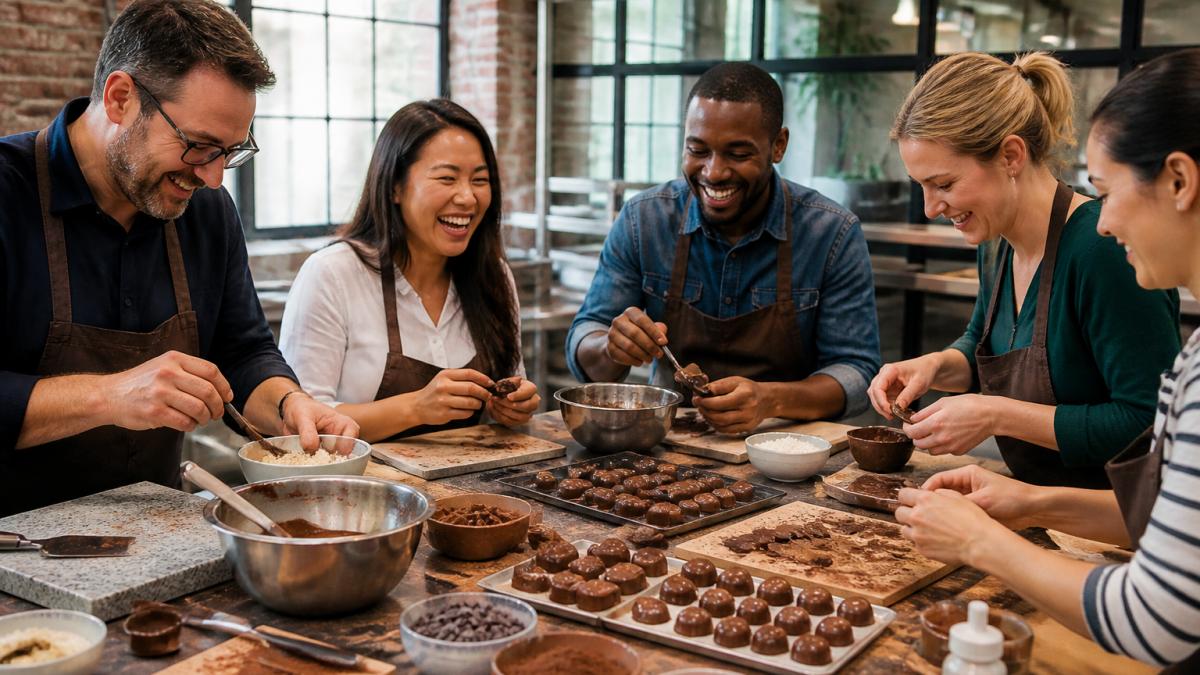
The difference shows up fast. Teams that participate in hands-on workshops report stronger communication, higher trust, and better collaboration when they return to daily work.
When people work together toward a creative goal, like crafting chocolate together, they naturally drop their guard and connect as humans first, colleagues second. That shift in dynamic carries back to the office.
Why this matters now: Remote and hybrid work has fractured many teams. In-person, interactive experiences fill that gap in ways video calls cannot.
Improved Communication Through Interactive Team-Building Activities for Large Groups
Better communication doesn’t happen by accident. It happens when people practice talking and listening in low-stakes environments where mistakes don’t carry professional consequences.
Interactive team-building activities for large groups work because they remove the hierarchy. When a manager and a junior employee are both figuring out how to temper chocolate or build something together, they’re equals solving a problem. That experience shifts how they communicate back in the office.
Common barriers fall away:
- People feel safer speaking up when they’ve just laughed together
- Cross-departmental groups discover they have more in common than they thought
- Quiet team members often contribute more in hands-on settings than in meetings
- Managers see different sides of their team members outside formal roles
The real benefit isn’t the activity itself, it’s the conversation that flows naturally from it. After working together on something creative, people ask different questions. They listen differently. They remember each other as whole people, not just job titles.
Building Trust and Stronger Workplace Relationships
Trust is the foundation of every high-performing team. Without it, people hold back. With it, they take risks, admit mistakes, and support each other.
Workplace relationships built on trust mean:
- Team members cover for each other without resentment
- People share ideas freely, not just when they’re certain
- Conflict gets resolved faster because people assume good intent
- Retention improves, people stay where they feel genuinely connected
A corporate team building workshop accelerates trust-building because vulnerability happens naturally in creative settings. When someone makes a mistake during an activity, their chocolate seizes, their creation doesn’t look right, the group responds with humour and help, not judgment. That experience rewires how people relate to each other’s imperfections.
Strong workplace relationships also reduce stress. When you genuinely like the people you work with, work feels different. It’s still demanding, but it’s not isolating.
Boosting Employee Engagement and Morale with Team-Building Workshop Ideas
Engagement drops when people feel disconnected from their team and their work. Morale suffers when the office feels like just another obligation.
Team-building workshop ideas that actually work share one quality: they’re experiences people want to talk about afterward. Not because they’re forced to, but because something memorable happened.
When employees participate in an interactive workshop:
- They feel valued (the company invested time and resources in them)
- They have something positive to discuss with colleagues and family
- They return to work with renewed energy and perspective
- They’re more likely to go the extra mile for teammates they’ve connected with
Morale isn’t about perks or free lunches. It’s about feeling part of something. A well-designed corporate team building workshop reminds people why they chose to work here and why their colleagues matter.
Breaking Down Barriers Between Departments and Management
Silos kill productivity. When departments operate in isolation, information doesn’t flow, problems don’t get solved efficiently, and resentment builds.
Barriers between management and staff are even more damaging. When leaders feel distant or unapproachable, employees disengage. They stop sharing concerns. They stop taking initiative.
A corporate team building workshop that mixes departments and levels forces interaction in ways normal work doesn’t. A finance person and a marketing person working together on the same project discover shared challenges. A manager and a junior employee collaborating on something creative see each other differently.
These interactions matter most:
- Cross-functional teams learn how other departments actually work
- Managers see how their decisions affect frontline staff
- Staff understand why decisions are made the way they are
- Everyone realises the “other side” is full of capable, reasonable people
The barriers don’t disappear in one afternoon. But cracks form. And when people see each other as humans first, working together becomes easier.
Team-Building Workshop Planning for Measuring Return on Investment
Most team building spend goes unmeasured. That is the gap this section closes. The aim is not a perfect financial model; it is a defensible, low-bureaucracy way to show whether a facilitated workshop changed how a team works, and whether that change held.
The mechanism matters. A facilitated workshop should end with agreed actions, not just good feelings. Ask the facilitator to capture, in the room, three to five specific behaviours the team commits to, for example, a weekly cross-team stand-up, a shared decision log, or a rule that questions are welcomed before solutions. Those commitments become your measurement anchors.
A realistic evaluation runs in four stages:
- Baseline (1-2 weeks before). Run a short anonymous pulse survey (8-10 questions) covering communication clarity, psychological safety, cross-team awareness and confidence in raising concerns. Keep it under five minutes so response rates stay high. Record objective baselines too: project cycle times, handover error rates, meeting attendance, and voluntary turnover for the participating group.
- Immediate reaction (same day). A three-question card: what was useful, what was not, and one thing you will do differently. This measures facilitation quality, not business impact, do not confuse the two.
- Behaviour check (4-6 weeks after). Re-run the pulse survey and ask managers for specific examples of the agreed behaviours happening. This is where most programmes fail: without a scheduled review, the commitments fade.
- Outcome review (3-6 months after). Compare the objective baselines. Look for direction of travel rather than precise percentages, because small teams produce noisy data.
| What you are testing | Practical indicator | When to check |
|---|---|---|
| Communication clarity | Pulse survey scores; fewer escalations to managers | 4-6 weeks |
| Cross-team awareness | Number of cross-department requests or joint projects | 3 months |
| Psychological safety | Willingness-to-raise-concerns score; near-miss reporting | 4-6 weeks |
| Retention | Voluntary turnover in participating teams vs comparable teams | 6-12 months |
| Delivery | Cycle time and rework rates on shared projects | 3-6 months |
Two cautions. First, avoid attributing every change to the workshop; note other variables such as restructuring, new hires or seasonal pressure. Second, do not promise a percentage return.
Book the 4-6 week review before the workshop happens. A diary entry is the cheapest way to prevent follow-through from slipping.
guidance on measuring people management practices is a useful starting point for survey design and avoiding common bias traps.
Creating Inclusive Experiences: Team-Building Activities for Improving Communication Across Diverse Teams
Inclusion isn’t an afterthought. It’s the foundation of whether a workshop actually works for everyone.
A diverse team is stronger. But only if the experience includes everyone, not just the people who naturally speak up or feel comfortable in group settings.
Team-building activities for improving communication must account for:
- Dietary requirements and allergies (vegan, gluten-free, nut allergies, religious restrictions)
- Physical accessibility (mobility, hearing, vision, neurodivergence)
- Comfort levels with group participation (some people need smaller group options)
- Language barriers (clear instructions, visual demonstrations, patience with questions)
- Cultural backgrounds (what feels fun to one person might feel uncomfortable to another)
The best workshops don’t just accommodate these differences, they design for them from the start. That means:
- Multiple ways to participate (hands-on, observational, leadership roles)
- Clear communication before and during the event
- Flexibility to adapt on the day
- Follow-up that includes everyone, not just the extroverts
When everyone feels included, communication genuinely improves. People who felt like outsiders suddenly contribute. Quiet team members find ways to participate that suit them. The whole team benefits.
inclusive workplace research confirms that teams where all members feel valued and included are significantly more engaged and productive. Inclusion isn’t nice to have. It’s essential to results.
Planning Your Next Interactive Workshop Experience
Start with the problem, not the activity.
A simple mapping helps:
- Siloed departments: mixed-department teams, shared problem-solving tasks, and a facilitated review of where handovers break down.
- New starters or a merged team: low-stakes creative tasks that let people introduce themselves through doing rather than presenting.
- Communication issues: paired and small-group exercises with clear turn-taking, followed by a facilitated debrief on what people noticed.
- Manager-staff distance: mixed-level teams where leaders participate as equals, not observers.
- Low morale after a difficult period: hands-on, tangible outcomes people can take away, with an explicit focus on shared achievement.
Group size and timing. Workshops generally work best between 15 and 100 people.
Venue and travel. Choose a venue that is easy to reach by public transport and has step-free access, accessible toilets and quiet space. Confirm the venue’s accessibility statement in writing rather than assuming.
Hybrid and distributed teams. If some colleagues join remotely, design for them deliberately.
Inclusion by design. Ask about dietary requirements, allergies, mobility needs, neurodiversity and participation preferences at booking, not on the day.
Budget the full experience. Include the workshop fee, venue hire if separate, travel, refreshments, materials and any takeaway items.
event planning guidance recommends starting planning 8-12 weeks ahead for larger groups, which gives time to survey the team, confirm accessibility needs and build anticipation.
At International Chocolate Events, we design hands-on workshops around your specific challenge and group size, and we can adapt the format for mixed on-site and remote participation. Book a chocolate team building event or explore our chocolate making workshops in London to see how an interactive experience can be shaped to your team. For larger off-sites combining several elements, learn more about planning corporate events for large groups.
Frequently Asked Questions
How can team-building workshops improve communication at work?
Team-building workshops create structured environments where employees practise open dialogue in low-pressure settings. Hands-on activities like collaborative chocolate-making require participants to share ideas, listen actively, and give feedback in real time. These shared experiences build familiarity and psychological safety, making it easier for colleagues to communicate effectively back at the office. The informal nature of interactive workshops often breaks down the formality that can inhibit honest conversation.
What are the main benefits of corporate team building?
Corporate team building strengthens communication, builds trust, boosts morale, and increases employee engagement. It breaks down silos between departments, helps staff understand each other’s perspectives, and creates a more positive company culture. Interactive workshops also improve problem-solving skills, reduce workplace stress, and increase retention by showing employees the organisation values their wellbeing and development. Teams that participate in structured team-building report stronger collaboration and higher productivity.
How do you measure the success of a team-building workshop?
Success can be measured through pre- and post-workshop surveys asking about communication comfort, trust levels, and collaboration. Track metrics such as internal project collaboration rates, employee retention, sick days, and engagement scores in the months following the event. Gather qualitative feedback from participants about relationships formed and barriers broken. Monitor whether teams that attended continue to apply lessons learned, for example, improved cross-departmental project outcomes or reduced conflict incidents. Some organisations also measure innovation submissions and voluntary team participation in follow-up initiatives.
Can team-building workshops work for very large groups or remote teams?
Yes, workshops can be scaled for large groups (50+ employees) by breaking participants into smaller facilitated sessions or rotating activities, ensuring everyone receives personalised attention. For hybrid or distributed teams, some providers offer virtual components combined with in-person experiences when possible, or deliver multiple sessions across different locations. The key is choosing a provider experienced in managing logistics for large, diverse groups and customising the experience to accommodate different working arrangements, dietary requirements, and accessibility needs. Bespoke planning ensures no one feels excluded regardless of team size or location.
