
Last Updated: November 14, 2026
Quick Summary
Logistics for hosting cooking classes at offsite venues means moving a working kitchen, menu, team and guests into a space you don’t control, and getting every part to arrive in the right order. Plan in three phases: six weeks out to lock in the venue, two weeks out to confirm suppliers and staffing, and forty-eight hours out for final confirmations. Treat an offsite class as an event with a kitchen inside it, not a kitchen that happens to be somewhere new.
- Ask whether the venue allows open flame or induction hobs and get delivery windows in writing.
- Run a site visit equipment audit and treat conditional items as missing.
- Break large groups into stations of 8 to 12 people, each with its own lead.
- Count one work surface per two guests and one sink per 20.
- Add 10 to 15 per cent contingency to the budget for hire and transport surprises.
Table of Contents
- Why Offsite Cooking Classes Need a Logistics Plan
- Your Cooking Class Event Planning Checklist
- Cooking Class Equipment Checklist for Any Venue
- Food Safety, Hygiene and Allergen Management
- Planning a Cooking Class for Large Groups
- Budgeting and Cost Planning for Offsite Cooking Classes
- Running a Corporate Cooking Class That Delivers Team Building
- Utilities, Waste and Cleanup Responsibilities
- Frequently Asked Questions
Why Offsite Cooking Classes Need a Logistics Plan
A hotel kitchen is built for its own team; an offsite venue is built for conferences, weddings and exhibitions.
Treat an offsite class as an event with a kitchen inside it, not a kitchen that happens to be somewhere new.
If you want the deeper version of the venue-side challenges, our guide to the logistics of mobile chocolate making workshops covers them in detail.
Your Cooking Class Event Planning Checklist
A cooking class event planning checklist is a dated list of decisions and confirmations that keeps the venue, suppliers, staff and guests moving toward the same day. It splits into three phases: six weeks out, two weeks out, and forty-eight hours out.
| Phase | What You Confirm | Why It Matters |
|---|---|---|
| Six weeks out | Venue, date, room, capacity, access times | Locks in the space before it books out |
| Two weeks out | Suppliers, staffing, equipment hire, allergens | Gives time to fix shortfalls |
| Forty-eight hours out | Deliveries, layout, contacts, contingency | Removes surprises on the day |
Six Weeks Out: Venue and Date
Start with the room, not the menu. Ask three questions before anything else:
- Does the venue allow cooking on site, and open flame or induction hobs?
- Is there a commercial kitchen, or only a prep area with a sink?
- What are the delivery and setup windows, and are they in writing?
Get the answers in the contract. A venue that “thinks” you can arrive at 8am will hand you the room at 10am. Check capacity honestly: a room that seats 80 for a talk often holds 40 around work surfaces.
Two Weeks Out: Suppliers and Staffing
Now confirm the things that have a lead time.
- Ingredient orders, with delivery dates and a named contact
- Equipment hire for anything the venue cannot supply
- Staff ratios and who does what on the day
Chase the dietary forms yourself. Waiting for guests to volunteer information is how a nut allergy becomes a problem.
Forty-Eight Hours Out: Final Confirmations
Send one email that lists everything, to everyone.
- Arrival time, loading bay location and parking
- Room layout and where each station goes
- Names and mobile numbers for the venue contact and your lead
Then print it. Phone signal in a basement events space is not a plan.
Cooking Class Equipment Checklist for Any Venue
A cooking class equipment checklist should cover four groups: cooking, cold storage, prep surfaces and cleaning. Anything the venue cannot confirm in writing goes on your hire list. Pair the checklist with an audit and a transport plan, because the gap between what a venue says it has and what is usable on the day is where offsite classes fail.
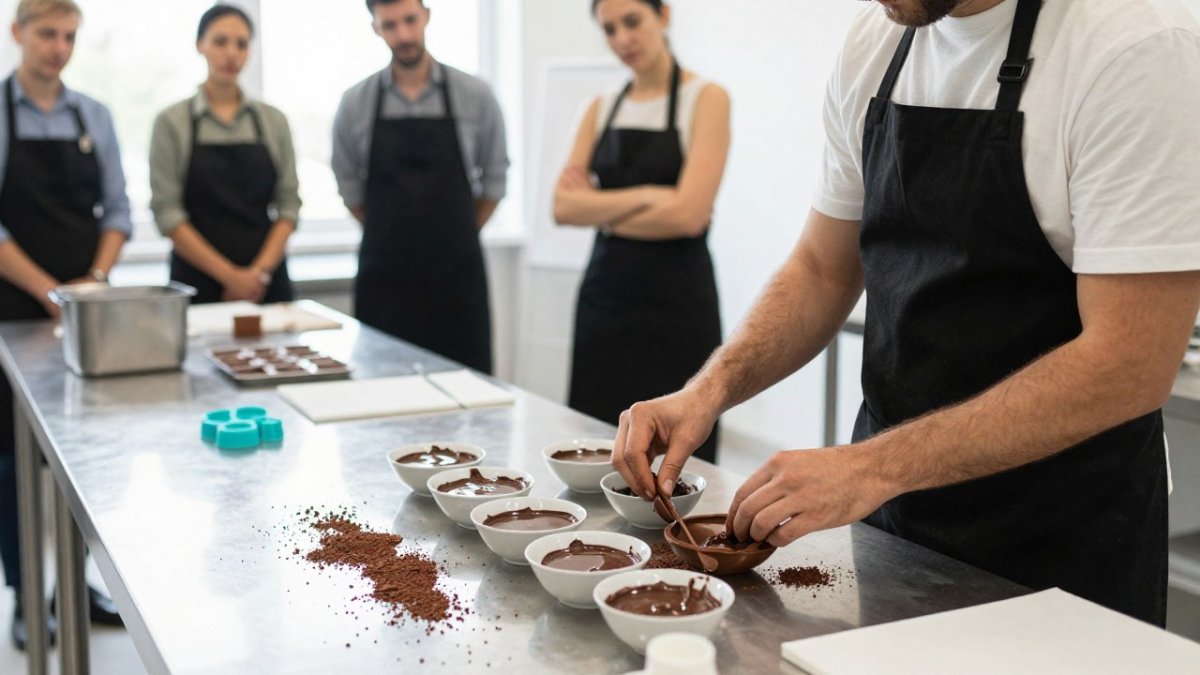
Run a site visit equipment audit
Do not audit from a floor plan. Walk the room with the venue contact and test each item rather than accepting a verbal yes.
- Cooking: switch on every hob ring and oven you intend to use, and confirm the fuel type (induction, electric, gas) matches your pans. Induction hobs need ferrous-based pans; aluminium or copper will not heat.
- Cold storage: measure usable shelf space and check the temperature with your own probe. A venue fridge running at 10°C is not cold storage.
- Prep: count work surfaces per station and check height. Standard event tables are often 750mm high, too low for comfortable knife work for taller guests.
Record each item as confirmed, conditional or missing. Conditional means the venue has it but with a restriction, such as a shared fridge or a single sink for the whole floor. Treat conditional items as missing.
Build the inventory sheet
Use three columns: venue confirmed, we bring, and we hire. Venues often overstate kitchen capacity because their events team has never cooked in the room, so ask to speak to the catering team directly.
Plan equipment transport
Once the we-bring and we-hire columns are settled, build a transport plan around weight, fragility and temperature.
- Cooking equipment: pack pans and moulds in rigid crates, not bags, and label each crate by station so setup is placing crates rather than sorting.
- Cold chain: use insulated boxes with ice packs for chilled ingredients, and keep a probe thermometer in the box to record temperature on arrival.
- Fragile items: wrap glass and ceramic in bubble wrap and carry them in the passenger vehicle if space allows.
Confirm the loading bay booking and lift dimensions before you pack. A crate that fits the van but not the service lift is a problem you discover at the worst moment.
Watch out: venues often supply domestic equipment rated for occasional use, so a domestic oven pressed into service for a full class may struggle to hold temperature when the door is opened repeatedly.
Food Safety, Hygiene and Allergen Management
Food safety at an offsite class comes down to three controls: temperature, separation and information. Get those right and most risks disappear before the first guest arrives.
Under UK food safety and hygiene guidance, anyone handling food must follow the same principles whether they work in a restaurant or a hired hall. That means:
- Keep chilled ingredients below 8°C and check with a probe thermometer
- Separate raw and ready-to-eat items, with separate boards and utensils
- Record fridge and delivery temperatures on a simple sheet
Allergens need more than a tick box. Collect requirements in advance, label every dish, and keep original packaging so guests can read it themselves.
Watch out: a venue sink used for flower arranging earlier that morning is not a food preparation sink. Confirm which sinks are food-safe in writing.
Planning a Cooking Class for Large Groups
A cooking class for large groups works when you break the room into stations of 8 to 12 people, each with its own lead, equipment set and timing. Above roughly 40 guests, the constraint stops being space and becomes flow: calculate capacity honestly, then design movement so no station waits and no lead is stretched.
Calculate capacity before you commit
Capacity maths is simple but easy to get wrong. Count one work surface per two guests, and one sink per 20. If the venue cannot meet that, reduce the group or bring portable stations. Adjust these working ratios for your menu:
- Work surfaces: one per two guests, with a minimum of 600mm width per person for knife work.
- Sinks: one food preparation sink per 20 guests, plus a separate handwash sink.
- Hobs: one ring per 10 guests for live cooking, or one shared demo hob per station if not.
Measure the room against these ratios rather than the venue’s stated capacity.
Design the flow
Three moves make large sessions feel personal:
- Station leads. One trained host per station keeps attention local. Brief them on the full menu, not just their station, so they can answer questions without escalating.
- Staggered starts. Send stations to the ingredients in waves. Two waves of four stations is easier to manage than eight moving together.
- Short demos, long doing. Keep the front-of-room demo under ten minutes, and repeat key steps at each station.
Map the room on paper with station positions, ingredient tables and the route between them. Mark the one-way flow if you can, because crossing routes cause collisions when guests carry hot or sharp items.
Plan staffing and timing
For groups heading toward triple figures, our guide to scaling interactive workshops for 100 guests sets out the staffing and equipment maths. Our guide to planning corporate events for large groups is also worth reading alongside it if the class sits inside a wider company event.
Build a timing plan covering setup, briefing, cooking, eating and breakdown. A typical 60-guest class runs 90 minutes setup, 15 minutes briefing, 60 minutes cooking, 30 minutes shared eating and 45 minutes breakdown.
Watch out: large groups generate heat, steam and noise quickly, so check ventilation and acoustics during the site visit. A room that is comfortable when empty can become unbearable with 60 people cooking, and a station lead who cannot be heard will lose the room.
Timing plan for a typical 60-guest cooking class
Budgeting and Cost Planning for Offsite Cooking Classes
Offsite class budgets fail in the same place every time: the venue line is estimated and everything else is guessed. Build the budget from a full list of lines, then add 10 to 15 per cent contingency for hire and transport surprises. The main cost lines are:
- Venue hire, including any early-access or late-vacate charge
- Equipment hire and delivery
- Ingredients, including spares for breakages
Pricing for a hands-on workshop depends on group size, location, menu and kit, so ask for a bespoke quote rather than working from a per-head guess. You can request a bespoke quote from our team once you have a date and a headcount in mind.
Watch out: venues that quote a day rate often bill setup and breakdown as extra hours. Ask what the access window includes before you compare two quotes.
Running a Corporate Cooking Class That Delivers Team Building
Design the session so every guest has a role:
- One person reads the method, one measures, one handles the equipment
- Stations swap tasks halfway so nobody is stuck on the same job
- The finished items get shared and tasted together at the end
The shared meal is the part people remember, and where the team-building actually happens, because conversation moves from the task to each other.
Our Truffle Express workshop is built for exactly this: a hands-on session that suits corporate team building, networking events and social occasions, and scales from small groups to large ones.
What most guides miss is that the value is in the doing, not the demo. A room watching one expert for an hour is a presentation.
Utilities, Waste and Cleanup Responsibilities
Utilities, waste and cleanup are the most commonly skipped part of offsite planning, and the most likely to cost you money at the end of the night. Agree who does what before you book. Put these in writing with the venue:
- Which power circuits you may use, and whether you need an extension lead
- Water access and whether hot water is guaranteed
- Who empties bins, and where the waste goes
Assign a cleanup lead on your own team. One named person with a checklist beats six people drifting toward the door. Leave the room as you found it.
Offsite cooking classes reward planning more than almost any other corporate event. The room, the kit, the food safety and the cleanup all have to line up, and the group only ever sees the fun part.
Frequently Asked Questions
How do you organise a cooking class at an offsite venue?
Start by defining the group size, budget and dietary needs, then shortlist venues with a commercial kitchen, adequate power and good transport links. Book at least six to eight weeks ahead, confirm public liability insurance and complete a site visit. Build a cooking class event planning checklist covering venue hire, equipment hire, ingredients, staffing and setup time. Confirm allergen controls with the venue and send a final run sheet 48 hours before the event.
What equipment does a venue need for a group cooking class?
A suitable venue needs commercial-grade hobs, ample work surfaces, refrigeration, handwashing stations and adequate ventilation. For a cooking class for large groups, check the number of hobs and prep stations against participant numbers, confirm power capacity for any extra equipment, and ask about waste disposal and cleaning. Use a cooking class equipment checklist to confirm what the venue supplies and what you must bring, including knives, boards, bowls, scales, thermometers and packaging.
How do you accommodate dietary requirements at a cooking class?
Collect dietary information at booking and share it with the venue and facilitator at least two weeks before the event. Under UK food law, the 14 major allergens must be declared, so plan separate prep areas and dedicated utensils for nut, gluten and dairy-free options. For vegan and gluten-free guests, provide clearly labelled ingredient alternatives and brief staff on cross-contamination risks. Confirm that all recipes and packaging are labelled accurately before the event.
How far in advance should you book a venue for a cooking class?
Book six to eight weeks ahead for groups under 30, and eight to twelve weeks for larger corporate events or peak dates. Venue hire availability tightens around December and summer party season, so early booking secures better rates and equipment. Confirm public liability insurance, cancellation terms and setup access times in writing. For a corporate cooking class with 60 or more people, allow extra lead time for staffing, ingredient sourcing and any bespoke menu planning.
