
Last Updated: November 1, 2026
Quick Summary
Incorporate team bonding into virtual cooking sessions by splitting the agenda roughly 60/40 between doing and talking, with short food-based icebreakers, breakout groups of three to four people, and a show-and-tell finish. Plan 60 to 90 minutes, which is the sweet spot for team bonding, and design the conversation with prompts rather than leaving chat to chance.
- An icebreaker should take under five minutes and involve movement or objects.
- Breakout groups of three to four people stop quiet colleagues from disappearing.
- Sessions under 45 minutes feel rushed and over two hours lose attention on a video call.
- Send the ingredient list at least a week ahead so people can shop.
- Run a five-question survey the day before and two weeks after to measure the effect.
Table of Contents
- Why Virtual Cooking Sessions Build Team Bonding That Lasts
- Virtual Cooking Class Icebreakers That Get Quiet Colleagues Talking
- Building a Virtual Team Cooking Class Agenda That Balances Cooking and Connection
- Choosing the Right Virtual Cooking Class Duration for Your Group
- Virtual Cooking Class Facilitation Tips for Deliberate Bonding
- Accessibility, Dietary Needs and Kitchen Equipment Alternatives
- Measuring Whether Your Session Actually Improved Team Connection
- Enquire About a Chocolate-Making Session for Your Team
- Frequently Asked Questions
Why Virtual Cooking Sessions Build Team Bonding That Lasts
Here is the core problem with most remote team building: people watch.
Cooking is different. Everyone has ingredients in front of them. Everyone has something to do with their hands.
At International Chocolate Events, we deliver hands-on chocolate-making workshops for groups of 10 to 100+.
Three things make it stick:
- Shared attention. Everyone focuses on the same steps at the same time.
- Low-stakes risk. Melting chocolate wrong is funny, not career-damaging.
- A visible outcome. You finish with something you made and can show off.
For teams considering a chocolate-based format specifically, our chocolate team building events are built around exactly this principle.
Virtual Cooking Class Icebreakers That Get Quiet Colleagues Talking
The best virtual cooking class icebreakers are short, physical, and tied to the food, not to awkward personal questions. A good icebreaker gets people touching ingredients and laughing within two minutes.
Skip “tell us a fun fact about yourself.” It stalls. Try these instead:
- Show your ingredients. Everyone holds up one item and says why they picked it. Takes 60 seconds and gets cameras on.
- Guess the cuisine. The host shows three unusual ingredients; teams guess the dish in chat.
- Kitchen tour in 10 seconds. Each person pans their camera across their workspace. Instant conversation.
- Worst kitchen disaster. One sentence each. Nobody forgets the person who set off a smoke alarm.
- Team name and mascot. Breakout groups pick a name tied to the recipe before cooking starts.
The rule of thumb: an icebreaker should take under five minutes and involve movement or objects. Once people have held something up to a camera, the ice is genuinely broken.
Building a Virtual Team Cooking Class Agenda That Balances Cooking and Connection
A strong virtual team cooking class agenda splits time roughly 60/40 between doing and talking. Cooking fills the silence; structured conversation gives the session a purpose beyond the recipe.
Here is a format that works for most teams:
| Time | Activity | Purpose |
|---|---|---|
| 0-5 min | Welcome and icebreaker | Get cameras on |
| 5-10 min | Recipe and equipment check | Remove confusion early |
| 10-30 min | Guided cooking, step by step | Shared activity |
| 30-40 min | Breakout groups finish and chat | Small-group connection |
| 40-50 min | Show and tell, tasting notes | Shared meal moment |
| 50-60 min | Wrap-up and follow-up plan | Lock in the outcome |
Two things make this agenda work. First, breakout groups of three to four people, because large calls let quiet colleagues disappear. Second, a show-and-tell finish, because presenting your plate to the group is a small, safe moment of pride.
If you are planning for a large group, our guide to scaling interactive workshops for 100 guests covers how to keep the bonding element intact as numbers grow.
Choosing the Right Virtual Cooking Class Duration for Your Group
The right virtual cooking class duration is 60 to 90 minutes for most teams. Under 45 minutes feels rushed; over two hours loses attention on a video call. But duration is not just a clock decision, it is a planning decision that starts weeks before the session and shapes everything from menu choice to how you confirm attendance.
Match the length to the goal:
- 30-45 minutes: Icebreaker-style sessions, simple no-cook recipes, large groups.
- 60-90 minutes: The sweet spot for team bonding. Enough time to cook, chat, and eat together.
- 2 hours or more: Smaller teams, more complex recipes, or a social occasion with a celebratory feel.
A practical planning timeline
Booking several weeks ahead gives teams time to plan. A workable timeline looks like this:
| When | What to do |
|---|---|
| 4-6 weeks before | Set one or two objectives (for example, “new joiners meet three people outside their team” or “the product and ops teams share a non-work experience”). Choose a date and a 60-90 minute slot. |
| 3-4 weeks before | Pick the cuisine or dish with the facilitator. Confirm dietary needs and equipment gaps in the same sign-up form. |
| 2 weeks before | Send calendar invites with the ingredient list, equipment alternatives and a two-minute pre-read. Ask for confirmation so you can plan breakout rooms. |
| 1 week before | Chase non-responders, confirm the final headcount and share the joining link plus a backup dial-in. |
| 1-2 days before | Send a short reminder with the recipe card and a “have these three things ready” note. |
Choosing a date and menu that fit the group
Pick a date that avoids month-end, quarter-end and major deadlines. For distributed teams, a slot that works across regions usually means early afternoon in one location and late morning in another; rotating the slot between sessions keeps it fair.
Menu choice should follow duration, not the other way round. A 45-minute session suits a no-cook dish such as a chocolate bark or a layered yoghurt pot.
Confirming attendance and preparing participants
Attendance is the quiet failure point of virtual sessions. A simple sign-up form that captures dietary needs, equipment gaps and a confirmation checkbox does more for turnout than a reminder email.
Preparation matters as much as the live call. Send the ingredient list at least a week ahead so people can shop, and include a “no-equipment” alternative for each step.
For a hands-on format that suits both small and large groups, the Truffle Express workshop is designed for corporate team building, networking events and social occasions, so you can explore the Truffle Express workshop and match the format to your team size.
Virtual Cooking Class Facilitation Tips for Deliberate Bonding
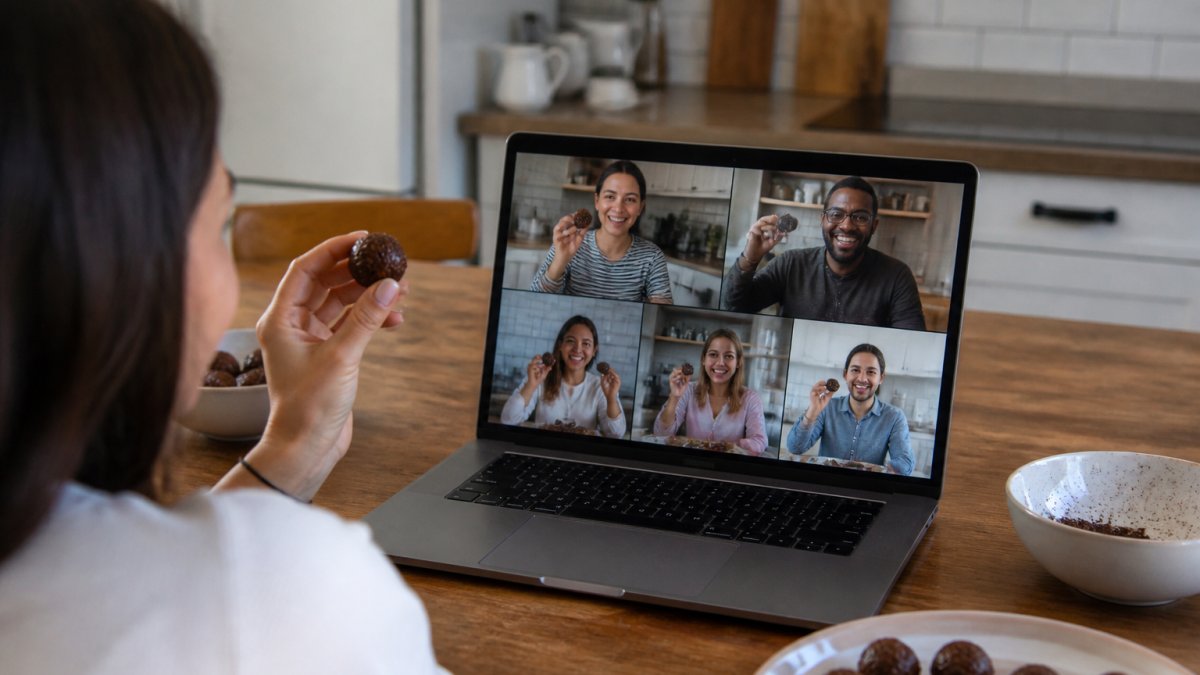
The facilitator decides whether a session bonds people or just fills an hour. Good virtual cooking class facilitation tips come down to one idea: design the conversation, don’t hope for it.
A common mistake is leaving chat to chance. Instead, build in prompts:
- Pair people deliberately. Mix departments in breakout rooms so people meet colleagues they never speak to.
- Ask one specific question per cooking step. “What’s the strangest thing in your fridge right now?” beats “any questions?”
- Name people gently. “Sarah, how’s your ganache looking?” pulls quiet colleagues in without pressure.
Rotating roles and breakout prompts
Assign roles at the start so everyone has a reason to speak. A simple rotation works well: one person reads the step, one watches the timer, one presents the plate at show-and-tell. Rotate the roles at the halfway point so no one is stuck as the note-taker.
In breakout rooms of three to four, give each group a prompt tied to the cooking task rather than to personal disclosure. Examples that work:
- “Decide as a group which plate looks closest to the photo, and why.”
- “Each person names one ingredient they would swap next time.”
- “Find one thing your kitchens have in common.”
These prompts give quiet colleagues a concrete reason to contribute without putting them on the spot.
Reflection questions that connect cooking to collaboration
Bonding sticks when people name what happened. Close the session with two or three reflection questions, answered in chat or aloud:
- “What did your group do when a step went wrong?”
- “Who helped you during the session, and how?”
- “What’s one thing you learned about a colleague that you didn’t know before?”
Keep the reflection to five minutes. The goal is to make the link between cooking together and working together explicit, not to turn the session into a workshop.
Troubleshooting logistics on the day
Most virtual cooking sessions hit at least one of these snags. Plan for them:
- Camera placement. Ask people to angle the camera so their hands and workspace are visible, not just their face. A short “show us your counter” moment at the start fixes most framing problems.
- Audio. Mute on entry, unmute for breakout rooms, and have a backup dial-in number. Background kitchen noise is the most common audio problem; a quick “mute when you’re blending” reminder helps.
- Recipe pacing. Cook the dish in parallel with the group rather than demonstrating ahead. Pause after each step and ask for a quick thumbs-up in chat before moving on.
What most guides miss is that bonding happens in the gaps, not the instructions. Leave space. Silence with a prompt is more productive than a facilitator filling every second.
Accessibility, Dietary Needs and Kitchen Equipment Alternatives
Inclusion is not a nice-to-have; it decides who can take part at all. A session that ignores dietary needs and equipment gaps excludes people quietly, and exclusion is the opposite of team bonding.
Plan for these before the day:
- Allergies. Ask about needs in advance so arrangements can be discussed with the organiser.
- Dietary requirements. Vegan, gluten-free and dairy-free versions should be ready, not improvised.
- Equipment gaps. Not everyone owns the same equipment, so plan for alternatives in advance.
Dietary and equipment needs can be planned for in advance, so everyone can take part. Our bespoke events for team building days or social occasions are available worldwide.
Measuring Whether Your Session Actually Improved Team Connection
You cannot prove a session worked without asking, and the asking needs to happen twice. Measure before and after with a short, simple survey.
Keep it to five questions on a 1-5 scale:
- I feel comfortable speaking up in team meetings.
- I know my colleagues as people, not just names.
- I would ask a teammate for help without hesitating.
Run it the day before and two weeks after. The gap between the two scores is your evidence. A two-week follow-up helps show whether the effect lasts beyond the day.
Add one open question: “What’s one thing you learned about a colleague?” The answers tell you more than any number.
Enquire About a Chocolate-Making Session for Your Team
The real test of any team activity is whether people still talk about it weeks later. Most don’t. A hands-on session with a clear structure, inclusive planning and deliberate facilitation gives you a far better chance.
At International Chocolate Events, we build bespoke chocolate-making workshops for teams of 10 to 100+, led by a master chocolatier with over a decade of experience. Every session is interactive and tailored to your group.
Get started with International Chocolate Events and give your team a shared experience they will actually remember. To request a bespoke quote or more information, get in touch and tell us your group size, date and any dietary needs.
Frequently Asked Questions
How do you make a virtual cooking class a genuine team-building activity rather than just a cooking demo?
The difference is facilitation, not the recipe. Build in icebreakers before anyone starts cooking, use breakout groups so people talk in small clusters, and set a shared challenge such as plating the best-looking plate for a friendly vote. Close with a short reflection where each person names one thing a colleague did that helped them. That structure turns a cook-along into team bonding because people collaborate, not just watch a chef.
How long should a virtual team cooking session last?
Most groups land between 60 and 90 minutes. A 60-minute session suits lunch-and-learn slots and smaller teams, while 90 minutes gives room for icebreakers, cooking, a shared meal and a closing activity. Sessions over two hours tend to lose energy on video calls. If you want a fuller experience, such as a chocolate-making workshop with tempering and decoration, plan for around 90 minutes and confirm timings with your provider in advance.
What should participants prepare before a virtual team cooking session?
Send a clear list at least a week ahead: ingredients, any equipment substitutes, and a note on dietary swaps. Ask people to set up their laptop or tablet at a work surface rather than a desk, test their camera and audio, and clear a space for their ingredients. For chocolate sessions, check that everyone has a heatproof bowl and a saucepan for a bain-marie. A short pre-session checklist removes the most common cause of delays.
How do you include quieter team members and people with different skill levels in a virtual cooking class?
Give quieter colleagues defined roles, such as timekeeper, plating judge or recipe reader, so they contribute without needing to compete for airtime. Use breakout groups of three or four, where speaking feels less exposed than a full-group call. For mixed skill levels, choose a recipe with simple base steps and optional advanced decoration, and ask the chef to demonstrate each stage twice. Pairing an experienced cook with a beginner in each breakout group also helps.
