Last Updated: November 21, 2026
Quick Summary
A corporate event planning checklist for workshops starts with one sentence stating what attendees should walk away able to do, then agrees objectives and headcount with the budget holder. Build a single shared template listing every task, owner and deadline, working backwards from the event date through foundation, production, final sprint, event week and follow-up phases.
- Split the run-up into foundation, production, final sprint, event week and follow-up phases.
- Set contingency at roughly one tenth of the total budget.
- A 2-3 hour session with two activities plus a break suits most team sessions.
- Collect dietary requirements at registration, not on the day.
- Send a short survey within two days, kept to five or six questions.
Table of Contents
- Start With Purpose: Objectives and Desired Outcomes
- Build Your Workshop Planning Template and Timeline
- Budget, Venue and Supplier Logistics
- Structuring a Corporate Workshop Agenda That Keeps People Engaged
- How to Decide Corporate Workshop Duration
- Room Layout, Catering and Hands-On Materials
- Workshop Evaluation Questions to Ask Afterwards
- Make an Enquiry to Book Your Chocolate Workshop
- Frequently Asked Questions
Start With Purpose: Objectives and Desired Outcomes
A corporate event planning checklist for workshops works best when it starts with one question: what should people walk away able to do? Every brief shapes the room, the timing and the materials.
Get the purpose down in one sentence before you book anything. Then agree the desired outcomes with whoever holds the budget. Most workshop briefs fall into four types:
- Skills transfer: people leave able to do something new
- Team bonding: people leave knowing each other better
- Problem solving: a real work issue gets tackled together
- Recognition: a reward for a team that has delivered
Write your objectives as observable results, not vague hopes. “Every attendee makes and packs their own box of truffles” beats “a fun day out”. Set a target attendee count at the same time, because headcount drives venue size, facilitator ratio and budget. For a practical view of how group size changes the format, see our guide to scaling interactive workshops for 100 guests.
Next, agree the event date and build a working timeline backwards from it.
Build Your Workshop Planning Template and Timeline
A workshop planning template is a single document that lists every task, its owner and its deadline. One shared file beats five email threads, and it gives you a planning checklist you can reuse for the next event.
Work in phases. A common approach is to split the run-up into foundation, production, final sprint, event week and follow-up. Here is a simple version we would use:
| Phase | Timing | Core tasks |
|---|---|---|
| Foundation | 8-12 weeks out | Objectives, budget, attendee count, date |
| Production | 6-8 weeks out | Venue, suppliers, facilitator, invitations |
| Final sprint | 2-4 weeks out | Dietary requirements, materials, run sheet |
| Event week | 5 days out | Confirm deliveries, setup plan, brief staff |
| Follow-up | 1-2 weeks after | Feedback, evaluation, thank-you notes |
Assign roles and responsibilities early. Name one owner per task: venue, catering, materials, communications and on-site logistics. Then set deadlines you can actually check.
Watch out: the most common mistake is leaving dietary requirements and accessibility needs until the final week. Suppliers need notice, and late changes cost money.
Budget, Venue and Supplier Logistics
Cost tracking starts with a budget line for each item, not a single lump sum. Split it into venue, catering and refreshments, facilitator fees, materials, equipment, transport and a contingency of roughly one tenth of the total.
Venue selection comes down to a few practical checks:
- Capacity that fits your attendee count with room to move
- A meeting room with tables you can rearrange
- Power sockets and Wi-Fi for any event technology
- Step-free access and accessible facilities
- A loading point for supplier deliveries
Book the venue as soon as the date is fixed. Popular spaces go early.
Then book vendors and suppliers against your run sheet. Confirm what each one delivers, when they arrive and who signs it off. Ask about setup time, waste removal and public liability insurance. For a hands-on food session, always check allergen handling and hygiene arrangements in writing.
Structuring a Corporate Workshop Agenda That Keeps People Engaged
A corporate workshop agenda should be built backwards from the learning outcomes, not forwards from the available room hours. The agenda is where the purpose agreed at the start either survives contact with the day or quietly disappears.
Start by translating each objective into a session format. A simple mapping keeps the agenda honest:
- Skills transfer: demonstration, guided practice, independent practice, feedback. Each participant should attempt the skill themselves at least once.
- Problem solving: issue framing, small-group diagnosis, options generation, prioritisation and a decision owner. The output is a shortlist or action list, not a discussion.
- Team bonding: paired tasks, mixed-table challenges and a shared product. The output is that people have worked with someone new on something concrete.
- Recognition: a short welcome, a hands-on highlight and time for informal conversation. The output is a genuine break from normal work, not a longer meeting.
A structure that works well for a two- to three-hour hands-on session:
- Welcome, housekeeping and the one-sentence objective (5 minutes)
- Short framing input with a visible example of the finished output (10 minutes)
- First hands-on task in small groups (25 minutes)
- Break with refreshments, away from work surfaces (15 minutes)
- Second task or team challenge that builds on the first (30 minutes)
- Group share-back, questions and feedback capture (10 minutes)
Put the facilitator’s brief in writing before the agenda is circulated. It should state what each session covers, what participants produce and how the group splits.
Plan the room layout alongside the agenda, because the two constrain each other. Cabaret-style tables facing a facilitator suit hands-on making; boardroom style suits discussion; theatre style only fits if people are watching rather than doing. For breakout activities, check that the venue can give you separate spaces or that one large room can be divided without noise bleeding between groups.
Send the agenda to attendees with the invitations, along with what to expect and whether they need to bring anything. People engage more when they know what they will be doing and why.
Watch out: the most common agenda failure is overfilling the time. A tight two-hour session with a clear finish beats a sprawling five-hour day where energy dips after lunch, and a facilitator who is running late will cut the reflection and feedback blocks first, which are exactly the blocks that turn activity into learning.
How to Decide Corporate Workshop Duration
Corporate workshop duration depends on the number of activities, not on how long the room is booked. As a rule of thumb:
- 60-90 minutes: one focused activity, ideal for lunch-and-learn slots
- 2-3 hours: two activities plus a break, the sweet spot for most team sessions
- Half day: three or more activities with time for reflection
- Full day: only when you add breaks, a proper meal and a change of pace
Longer is not better. A tight two-hour session with a clear finish beats a sprawling five-hour day where energy dips after lunch.
Room Layout, Catering and Hands-On Materials
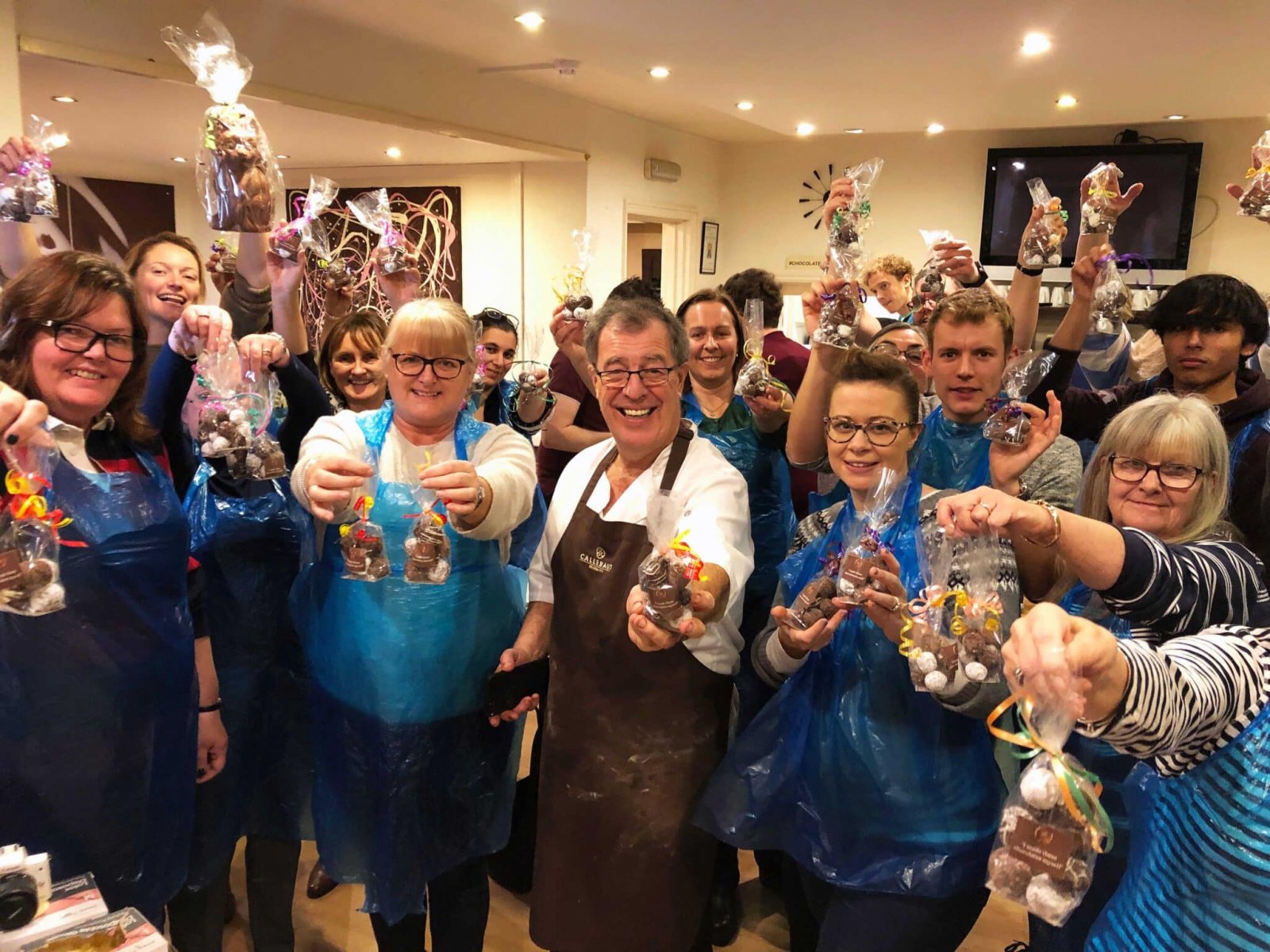
Room layout decides how well a workshop flows. Cabaret-style tables facing a facilitator suit hands-on sessions. Boardroom style suits discussion.
Check the practical details before the day:
- One workstation per four to six people, with clear space between tables
- All materials pre-portioned and laid out before guests arrive
- Aprons, gloves and wipes within reach
- Audio-visual equipment tested an hour before start
- A named person on site for on-site logistics
Catering needs the same care. Collect dietary requirements at registration, not on the day, and confirm allergens in advance.
Workshop Evaluation Questions to Ask Afterwards
Workshop evaluation turns a good day into evidence you can take to leadership. The gap most checklists leave is measurement: they ask whether people enjoyed it, but not whether the session changed what people can do. Agree how you will measure the session at the planning stage, before the event rather than afterwards.
- Attendance and completion: registration numbers, actual attendance, no-shows and whether participants stayed for the full session. Collect from the registration list and a simple sign-in sheet or platform report.
- Participation: how many people contributed, how many groups produced an output, and whether remote participants spoke. Collect through facilitator notes and table-lead feedback.
- Learning gains: whether participants can demonstrate the skill or apply the concept. Collect through a short pre- and post-session self-rating against the objective, a practical output reviewed by the facilitator, or a brief knowledge check at the end.
- Satisfaction and relevance: whether the session was useful and well run. Collect through a short survey sent within two days, while the experience is fresh.
- Post-event application: whether people used what they learned. Collect through a follow-up question sent two to four weeks later to participants and, where appropriate, their line manager.
A short survey sent within two days gets the best response. Keep it to five or six questions and tie each one to an indicator:
- How relevant was the session to your role?
- What is one thing you will use from today?
- How clear were the instructions and the facilitator’s explanations?
- Did you work with someone new or contribute to a group output?
- Would you recommend this format to another team?
- What one change would improve the session?
Pair the survey with attendance records, facilitator notes and any outputs produced during the session. Then compare the results against the learning outcomes you set at the start. If the objective was team bonding, ask whether people met someone new and whether mixed tables worked.
Report the results in a short summary, with the objective, the result and one recommended change for next time.
Watch out: evaluating only satisfaction gives you a pleasant score and no evidence of learning. If the budget holder asked for skills transfer or problem solving, agree the learning-gain measure before the event, because it is difficult to reconstruct afterwards.
Make an Enquiry to Book Your Chocolate Workshop
A hands-on chocolate session can fit neatly into a corporate event planning checklist for workshops. International Chocolate Events brings a master chocolatier’s expertise to groups of 10 to 100+.
Our Truffle Express session suits team building, networking and social occasions, and we can tailor the content to your brief. If you are weighing up formats, the Truffle Express workshop details set out what the session involves. For teams spread across sites, our bespoke global events cover options wherever your people are. When you are ready to talk numbers, contact Gerry Wilton and the team for a quote.
Tell us your date, headcount and any dietary or access needs, and we will discuss how the session can be shaped around them.
Planning a workshop should feel exciting, not like a second job. The checklist above gives you the structure; the right partner gives you the room, the materials and the expertise. International Chocolate Events offers bespoke workshops, scalable formats for 10 to 100+ guests, and a master chocolatier with over a decade of experience.
Frequently Asked Questions
How far in advance should you plan a corporate workshop?
Allow several weeks for a workshop of 30 or more people. The early weeks cover objectives, budget approval and venue or supplier booking, while the final month handles registration, dietary requirements and materials. Smaller groups can sometimes be arranged in three to four weeks, but a longer runway gives you room to confirm headcount and special requests without rushing. Build your event planning checklist backwards from the workshop date so every deadline is visible.
How long should a corporate workshop last?
Most corporate workshops run between two and four hours. A two-hour session suits a single focused activity, such as a hands-on team-building class, while half a day allows for introductions, a main activity, a break and a debrief. Corporate workshop duration should match the learning outcomes you set: if you want reflection and discussion, add 30 to 45 minutes after the activity. Avoid stretching past four hours without a proper break, as attention drops sharply.
What should be included in a workshop planning checklist?
A solid event planning checklist covers objectives and desired outcomes, target audience and attendee count, budget and cost tracking, venue selection, agenda, catering and dietary requirements, suppliers, audio-visual equipment, accessibility, roles and responsibilities, and post-event evaluation. For hands-on sessions, add materials, facilitator readiness and room layout. Group tasks by timeline, from three months out to the day itself, so nothing is left until the last week.
How do you keep participants engaged during a workshop?
Mix short presentations with hands-on activity, and keep any single talking segment under 15 minutes. Interactive formats such as chocolate-making work well because everyone has a task and a tangible result to take away. Use small groups to lower the pressure for quieter attendees, build in a break for informal conversation, and close with a short debrief so people connect the activity to their working day. Send a follow-up note within a week to keep the momentum going.
