
Last Updated: November 8, 2026
Quick Summary
Look for a chocolate class that teaches real technique with real chocolate containing cocoa butter, gives you your own station, and is led by a working chocolatier who explains the why. Ask how much time goes to tempering, moulding and ganache, and confirm the guest-to-tutor ratio and hands-on minutes before you book.
- Tempering is the most useful skill a class can teach and the one most often skipped.
- Ask for the split in minutes between demonstration and hands-on time at your own station.
- Match session length to your goal: 60-90 minutes for social events, 3 hours for serious learners.
- Allergen planning should start at booking, with the plan confirmed in writing.
- Request a quote in GBP that itemises inclusions so you can compare like with like.
Table of Contents
- What a Good Chocolate Class Actually Teaches You
- Tutor Credentials, Class Size and Hands-On Time
- Chocolate-Making Class Duration: What Fits Your Group
- What a Corporate Chocolate-Making Workshop Should Include
- How a Mobile Chocolate-Making Workshop Works on Site
- Allergens, Dietary Needs and Accessibility
- Your Chocolate Workshop Booking Checklist
- Make an Enquiry for Your Group
- Frequently Asked Questions
What a Good Chocolate Class Actually Teaches You
A good chocolate class teaches you how chocolate behaves, not just how to melt it. A good session is built around a simple idea: you should leave able to repeat the result at home. That means real technique, real ingredients, and your own hands on the tools.
Here is what separates a good class from a forgettable one:
- Real chocolate, with cocoa butter in it, not vegetable-fat coating
- Your own station, so you do the work rather than watch
- Finished creations you package and take away
- A tutor who explains the why, not just the steps
If you want to see the hands-on format in detail, our Chocolate Making Experience walks through tempering, moulding and ganache from start to finish.
Techniques to Look For: Tempering, Moulding and Ganache
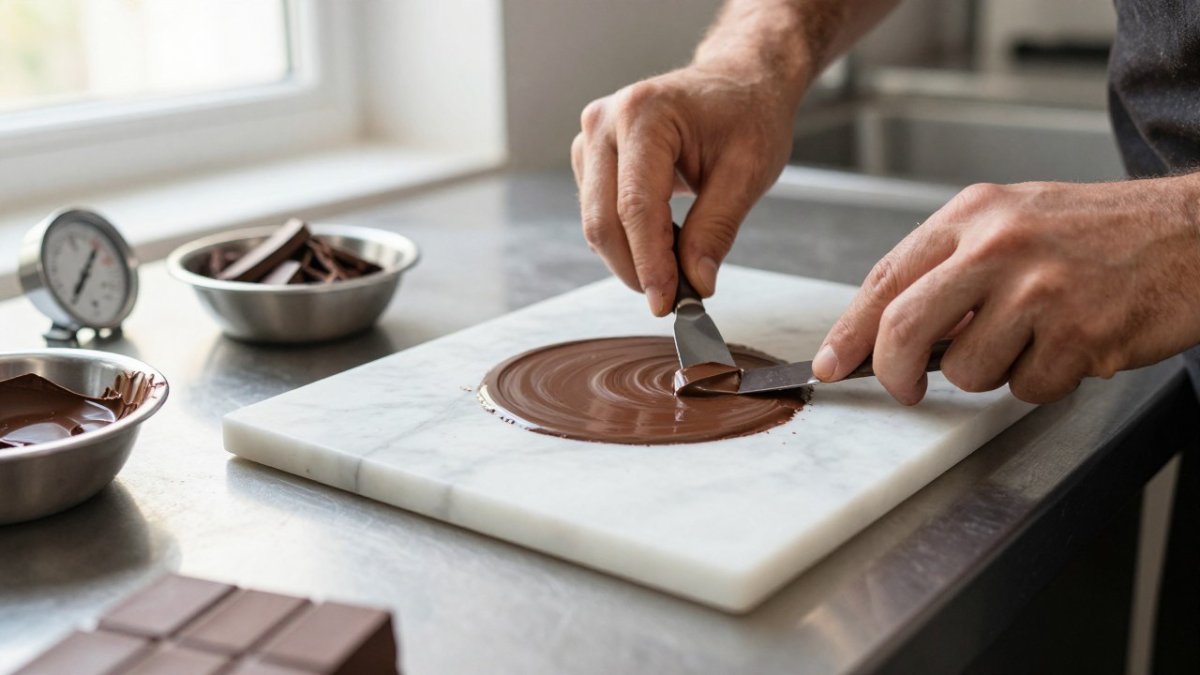
Tempering is the controlled heating and cooling of chocolate so it sets glossy and snaps cleanly. It is the single most useful skill a class can teach, and the one most often skipped.
Moulding covers filling and releasing moulds to make bars, slabs and shaped pieces. Ganache is the emulsion of chocolate and cream behind truffles, and it is where texture is won or lost.
Ask any provider how much time you spend on each. If tempering gets ten minutes of demonstration and no practice, the class is entertainment, not teaching.
Tutor Credentials, Class Size and Hands-On Time
A cheap session with one demonstrator and forty guests is a show. Look for a tutor with genuine confectionery experience and a ratio that allows individual guidance.
Ask three questions before you book:
- Who is teaching? Look for a working chocolatier, not a host reading a script.
- How many per tutor? Smaller groups mean hands-on help when your chocolate blooms or your ganache splits.
- How much is hands-on? Aim for most of the session at your own station.
Chocolate-Making Class Duration: What Fits Your Group
The useful question is not just how long a class is, but what you can do afterwards.
Match the length to the goal:
| Session length | Best for | What you make | What you should be able to do afterwards |
|---|---|---|---|
| 60-90 minutes | Social events, large groups | Dipped truffles, decorated bars | Dip and decorate; recognise tempered chocolate |
| 2 hours | Team building | Truffles, rochers, moulded shapes | Make and roll ganache; fill and release a simple mould |
| 3 hours | Serious learners | Tempered bars, ganache, full range | Temper by seeding or tabling; mould, fill and finish a range |
Distinguish demonstration from genuine hands-on instruction by asking how much of the session is at your own station. Ask for the split in minutes.
Value is not the same as price. Ask what is included in the price (ingredients, equipment, aprons, packaging, refreshments, take-home products) and whether there are extra costs for dietary substitutions or larger groups. Request a quote in GBP that itemises inclusions so you can compare like with like.
For groups of mixed experience, our Truffle Express workshop fits different sizes and time slots without cutting the hands-on element.
What a Corporate Chocolate-Making Workshop Should Include
A corporate chocolate-making workshop should deliver a shared task with a visible result. That is what makes it stick.
Look for these inclusions:
- All ingredients and equipment, with nothing hidden as an extra
- Aprons and packaging, so everyone leaves with a finished box
- A setup and clear-down team, so your venue is left as found
- Options for dietary needs built in, not bolted on
- A facilitator who reads the room and keeps energy up
The test is simple. If the session could run without anyone touching chocolate, it is not team building.
How a Mobile Chocolate-Making Workshop Works on Site
A mobile chocolate-making workshop brings the setup to your venue.
Logistics decide whether this works. Chocolate needs a cool room, stable tables and access for equipment. Confirm the space, the power supply and the timing before the day. For the full picture of what a mobile setup involves, read our guide to the logistics of mobile chocolate making workshops.
Check the space, not just the headcount.
Allergens, Dietary Needs and Accessibility
Allergen planning should start at booking, not on the day. Chocolate work touches milk, nuts, gluten and soya, so ask how the provider manages cross-contact in the room.
Cover these before you confirm:
- Nut allergies: separate stations, sealed ingredients and clean tools
- Vegan and dairy-free: dark chocolate with no milk solids
- Gluten-free: check every decoration and inclusion
- Accessibility: step-free access, seating and worktop height
- Age suitability: what younger guests can safely handle
Ask any provider for the plan in writing.
Your Chocolate Workshop Booking Checklist
Use this chocolate workshop booking checklist before you commit.
- Confirm the tutor’s experience and who actually teaches
- Ask the guest-to-tutor ratio and hands-on time
- Match session length to your group and goal
- Get the full inclusion list and any extra costs in writing
- Confirm allergen and dietary handling
- Check accessibility, age limits and venue requirements
- Ask what guests take home
- Request photos and references from past events
- Confirm setup, clear-down and arrival times
- Agree a quote in GBP with no hidden extras
Pricing depends on quantity, dates and delivery, so check the International Chocolate Events website or request a quote for current prices.
Make an Enquiry for Your Group
The last step is a conversation. Tell us your group size, date, venue and any dietary needs, and we will shape a session around them. We run events for groups from 10 to 100+, with an experienced master chocolatier.
Start with our chocolate team building events page to see the formats, or contact Gerry Wilton and the team for a bespoke quote.
Booking the right class comes down to three things: real technique, real hands-on time, and a tutor who can guide you personally. International Chocolate Events brings a master chocolatier with over a decade of experience to your venue, scales from 10 to 100+ guests, and tailors every session to your group’s needs. Get started with International Chocolate Events and give your team a chocolate-making event they will still be talking about next quarter.
Frequently Asked Questions
What should you expect from a chocolate-making class?
A good class is built around technique rather than a demonstration you watch from a chair. Ask before booking how much of the time is yours at the workbench, how many people share a station, and whether ingredients, moulds and packaging are included in the price.
How long should a chocolate-making class last?
Tempering needs a settled working rhythm, so a short session can skim the surface. For larger groups, add setup and reset time to the schedule.
Do you need any experience to take a chocolate-making class?
No. Beginner classes generally assume nothing. What matters more is the tutor-to-participant ratio: with one tutor to 40 people, guidance thins out quickly. If you have baked or worked with sugar before, say so when booking.
What questions should you ask before booking a chocolate workshop?
Work through a chocolate workshop booking checklist: tutor experience, group size and station sharing, class duration, what is included in the price, allergen and dietary handling, accessibility of the venue, and whether the provider travels to you. Confirm cancellation terms and any extra costs before you commit.
