
Quick Summary
Scaling a mobile workshop business means building a system that runs without you on site. Stabilise your core workshop first, then write standard operating procedures, plan equipment and power, hire and train staff, and use booking software to plan routes.
- Confirm timing, guest experience and setup work the same way at every event before adding new formats or locations.
- Write step-by-step SOPs covering preparation, tempering, guest briefing, allergies and load-out before hiring new staff.
- Calculate total power load against the venue circuit rating, and ask the venue for socket locations in writing.
- Keep finished and tempered chocolate between about 15°C and 18°C, away from direct sun and draughts.
- Use booking software to hold staff availability, venue access notes and visit routes on one calendar.
Table of Contents
- Stabilise Your Core Workshop Before You Add Anything
- Write Standard Operating Procedures Before You Hire
- Plan Your Equipment, Transport and Power Setup
- Size the kit to your typical group, not your biggest one
- Power: calculate the load before you accept the booking
- Protect delicate machines from vibration and shock
- Temperature-controlled transport and load-in checklists
- Food-safety compliance while you are mobile
- Cold-chain and environmental control in transit
- Match the equipment to the event format
- How to Hire Staff for a Mobile Workshop Business
- Set Up Booking and Scheduling Software to Manage Routes
- Build Marketing Strategies That Fill Your Calendar
- Book Your First Scaled Event Through International Chocolate Events
- Frequently Asked Questions
Last Updated: November 5, 2026
Scaling a mobile workshop business is less about adding events and more about building a system that runs without you in the room. For International Chocolate Events, the difference between a rushed event and a polished, repeatable one comes down to how well the core workshop is planned, equipped and staffed.
Stabilise Your Core Workshop Before You Add Anything
Do not add new formats, locations or bigger group sizes until your current workshop runs the same way every time. Growth multiplies whatever is already there.
Start by checking three things at every event you run:
- Timing: Did the session finish within the planned window?
- Guest experience: Did people leave with a finished product and a clear sense of what they learned?
- Setup and pack-down: Did the kit arrive, work and leave the venue without delays?
Log problems as they happen; repeated issues point to a process gap to fix before taking on more work.
Write Standard Operating Procedures Before You Hire
Standard operating procedures (SOPs) are written step-by-step instructions for each task. Write them before you hire, so new staff learn the same method every time.
Cover at least these areas:
- Pre-event preparation and packing lists
- Chocolate tempering and handling temperatures
- Guest briefing and safety instructions
Keep each SOP short, dated and easy to find on a phone, and review them after every few events.
Plan Your Equipment, Transport and Power Setup
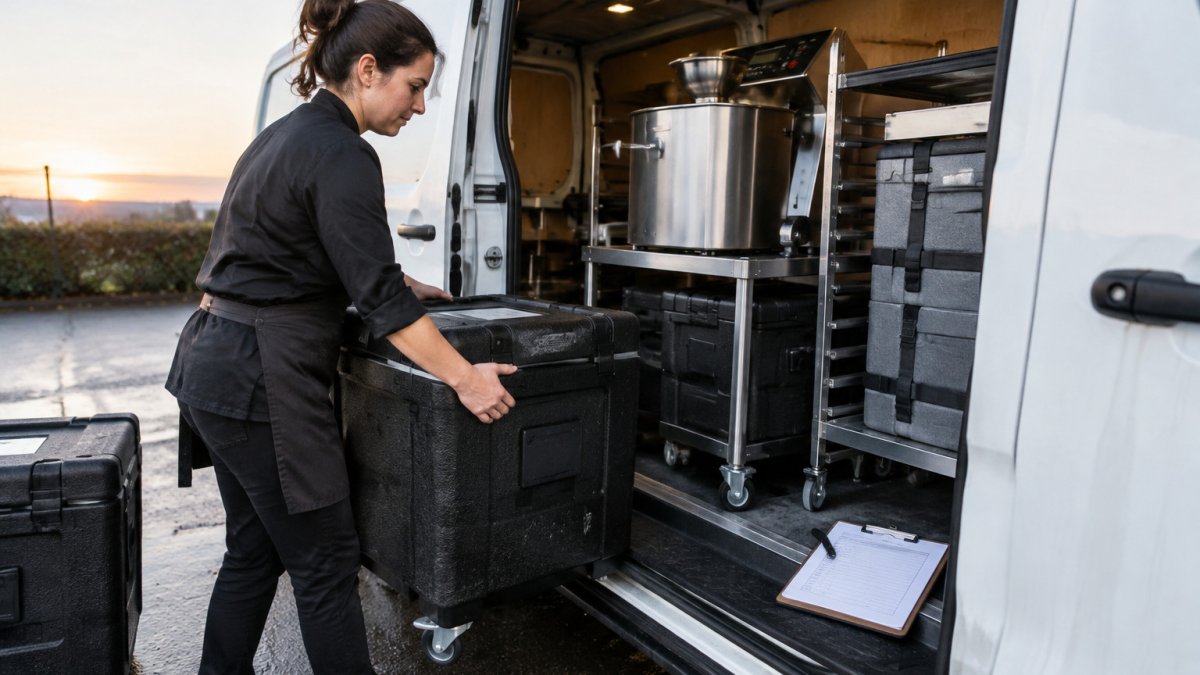
Mobile chocolate work depends on equipment that performs away from a permanent kitchen. Chocolate is sensitive to heat, humidity and rough handling, so treat the van as a second production room: everything in it has a fixed home, a power draw and a temperature limit written down before the first booking.
Size the kit to your typical group, not your biggest one
Match tempering and melting capacity to the group size you run most often, then hire or borrow extra capacity for outliers rather than buying for the once-a-year corporate booking.
Your core kit list should cover:
- Tempering machines and melting tanks sized for your typical group, plus one spare bowl set per machine
- Insulated transport trolleys and cool boxes with data-logging thermometers
- Work surfaces, aprons, gloves and food-grade cleaning supplies
Power: calculate the load before you accept the booking
Most venues quote ‘a few sockets’ without knowing what a tempering machine draws. Add up the running wattage of every device you will switch on at once and compare it with the venue’s circuit rating.
Ask the venue, in writing, for:
- The number and location of sockets in the prep and guest areas
- The circuit rating and whether other equipment (catering urns, PA, heaters) will share it
- Whether a generator is permitted on site and where it can sit (many venues ban fuel generators indoors or near fire exits)
Test the full load at base before the event: run every device simultaneously for the length of a session and watch for tripping, voltage drop or a machine that never reaches tempering temperature.
Protect delicate machines from vibration and shock
Tempering machines and melting tanks contain precision thermostats, augers and motors that do not tolerate road vibration or a dropped tailgate. Transport them in original crates or foam-lined flight cases, strapped to the load floor rather than stacked, heaviest items over the axle. If you carry machines loose, fit anti-vibration matting and avoid routes with long stretches of broken surface.
Temperature-controlled transport and load-in checklists
A simple load-in checklist helps every event start on time:
- Confirm venue access time, parking and any congestion or clean-air zone charges for the van
- Check power supply, socket locations and circuit rating against your load calculation
- Set up tempering equipment and let it reach temperature, verified with a probe thermometer
A matching load-out checklist prevents the other common failure, leaving kit behind or packing wet equipment into a dry van:
- Switch off and unplug every device; allow machines to cool before packing
- Clean and dry work surfaces and utensils on site where facilities allow
- Count machines, bowls, thermometers and tools against the kit list
Food-safety compliance while you are mobile
Operating away from your registered base does not suspend food hygiene duties. Under UK food law, food businesses must register with the local authority where their base is, and operate to the same hygiene standards on site as at base. In practice that means:
- A written food safety management system based on HACCP principles, covering transport, on-site prep and service
- Temperature records for the cool box and for any cooked or melted ingredients
- Allergen information for every ingredient you bring, kept with the kit and available to guests on request
Cold-chain and environmental control in transit
Chocolate is happiest in a narrow band, most practitioners aim to keep finished product and tempered chocolate between about 15°C and 18°C, away from direct sun and draughts. In a van, use insulated boxes with frozen gel packs rather than loose product, and a thermometer you can read without opening the lid. In hot weather, run the van’s air conditioning to the load area where possible; in cold weather, protect product from frost and from rapid warming when it comes into a heated venue, a sudden temperature swing is as damaging as sustained heat.
Match the equipment to the event format
A corporate team day, a wedding favour workshop and a school session each need different kit.
The table below summarises the key power, temperature and checklist figures from the equipment section.
| Item | Value | Note |
|---|---|---|
| Single 13A socket on standard ring main | Roughly 3kW | Compare combined load with venue circuit rating |
| Target temperature for finished and tempered chocolate | About 15°C to 18°C | Away from direct sun and draughts |
| Load-in step | Verify with probe thermometer | Before guests arrive |
| Machine calibration after transit | Check with probe thermometer | Drift of two or three degrees ruins a batch |
| Load-out step | Allow machines to cool before packing | Switch off and unplug every device first |
| Equipment transport | Original crates or foam-lined flight cases | Strapped to the load floor, heaviest over the axle |
How to Hire Staff for a Mobile Workshop Business
Hire people who can work calmly in unfamiliar spaces, follow your SOPs and talk comfortably with groups. Technical chocolate skills matter, but reliability and communication matter just as much away from your own kitchen. As you scale, the first hire is usually a second pair of hands who can also lead a session; later hires specialise into lead facilitators, setup and pack-down crew, and a coordinator who runs the calendar.
Decide the role before you advertise
Write the role as a set of tasks, not a personality. Be explicit about travel, early starts, weekend work and the fact that the job is in venues, not in a kitchen.
When recruiting, look for:
- Experience with food handling or hospitality
- Comfort leading small groups of adults, and the ability to keep a session to time
- Willingness to travel and work irregular hours, with a full clean driving licence if they will drive the van
Meet your legal duties as an employer
Before the first hire starts, you need the paperwork that UK employers are expected to hold:
If you use freelancers or self-employed facilitators, be clear about status and keep contracts that reflect how the work is actually done, a facilitator you control like an employee may not be genuinely self-employed.
Train against your SOPs, not against your memory
Cover at least:
- Pre-event preparation and packing lists
- Chocolate tempering and handling temperatures, including how to verify with a probe thermometer
- Guest briefing and safety instructions
- Allergy and dietary handling, including how to answer guest questions and when to escalate
Build a rota that protects quality
As bookings grow, the rota becomes the constraint. Plan staff against events, not hours, and build in travel time between venues.
Retain the people who make scaling possible
Turnover is the hidden cost of scaling a mobile business, because every replacement needs shadowing and sign-off. A short debrief after each event, captured in the same log you use for timing and setup issues, turns staff experience into process improvement.
Set Up Booking and Scheduling Software to Manage Routes
Once you run events across several locations, a shared calendar is no longer enough. Booking and scheduling software can help a mobile workshop business hold enquiries, confirm dates, assign staff and plan travel routes in one place.
Choose a system that does the following:
- Shows staff availability and equipment assignments on one calendar
- Stores venue details, access notes and allergy information against each booking
- Sends reminders to the team and clients before each event
- Lets you plan the order of visits so vans travel efficiently
Test the software with a few real bookings before you rely on it, and check that your team can use it on a phone while on the road.
Build Marketing Strategies That Fill Your Calendar
For corporate work, focus on the people who plan team days: HR managers, learning and development leads and event coordinators.
Practical steps include:
- Publish clear guides that answer the questions planners ask before booking
- Share photos and short videos from past events, with the client’s permission
- Ask every client for a review or a referral once an event is complete
- Follow up enquiries within one working day
Track which channels produce confirmed bookings, then put more effort into the ones that work.
Book Your First Scaled Event Through International Chocolate Events
If you are planning a larger event and want the experience handled by specialists, get in touch to discuss your group size, dates and budget.
Ask about dietary needs, travel and set-up requirements when you make an enquiry. If you are planning an event beyond your local area, the worldwide event options show how the experience can be adapted to different destinations and group types.
Frequently Asked Questions
How do you scale a mobile workshop business?
Scale in stages rather than all at once. First make one workshop format reliably profitable and repeatable, then document it in standard operating procedures so that someone other than the founder can deliver it. Next add capacity through a second vehicle or a second trained operator, and only then expand marketing into new areas. Each stage should be tested on real bookings before the next one begins, so that quality does not fall as volume rises.
When should a mobile workshop business hire its first employee?
Hire when the founder is turning away bookings or when delivery quality starts to slip because one person cannot run prep, transport, setup and the workshop itself. Before hiring, write the standard operating procedures and job descriptions so the new person can be onboarded consistently. A part-time assistant for setup and load-in often gives the best return before a full-time hire is justified.
What systems does a mobile workshop business need to scale?
At minimum you need a booking and scheduling system that handles routes, travel time and equipment availability, a written checklist for each event, a shared record of client dietary requirements and allergies, and a simple way to track costs per event. Good booking software reduces double bookings and makes it easier to hand scheduling to a staff member. Choose tools that integrate with your calendar and invoicing, and avoid buying more software than your team will actually use.
Is it better to add another vehicle or hire another technician first?
It depends on where the bottleneck sits. If you have enough trained people but cannot reach all venues in a day, add a vehicle. If you have spare capacity in transport but only one person who can run the workshop, hire and train a second operator first. Adding a vehicle without a second trained person usually leaves equipment sitting idle or pushes quality down.
