
Last Updated: October 27, 2026
Quick Summary
The best outdoor team building in London matches the activity to your team’s goal and size, not just to what is exciting. Treasure hunts and orienteering suit strategy and communication, park relays suit simple group energy, and adventure activities suit teams already comfortable together.
- Shortlist formats by objective first, then by group size, then by budget.
- Treasure hunts and orienteering reward different strengths and force decisions about when to split up.
- Relay games are quick and easy to run but can reward speed over thought.
- Adventure activities carry more physical risk, so check safety briefings, instructor qualifications and insurance.
- Request an itemised quote covering staffing, permits, insurance, catering and the rainy-day plan before comparing prices.
Table of Contents
- What Makes an Outdoor Team Building Adventure Work
- Treasure Hunts and Orienteering Challenges
- Park-Based Team Challenges and Relay Games
- Adventure Activities for Bolder Teams
- Outdoor Team Building Ideas Near London by Team Size
- Team Building Cost: What to Budget per Person
- Booking Your Team Building Activity Day
- Frequently Asked Questions
Team building outdoors in London gives groups a chance to step away from the office and work through a shared challenge together. The right activity can build trust, sharpen communication and leave colleagues with something to talk about for weeks. The wrong one can feel forced, expensive and quickly forgotten. This guide looks at which outdoor team building adventures work in London, and why. It also considers where an indoor option may suit a team better.
What Makes an Outdoor Team Building Adventure Work
An outdoor team building adventure works when every person has a real role in reaching the goal. If one or two confident people do all the talking, the rest of the group simply watches. Choose formats that require different skills from different people, such as navigation, planning, physical effort and quick decisions.
A common mistake is picking the most exciting activity rather than the most suitable one. Ask three questions first: how many people are attending, how mobile they are, and what the team actually needs to improve. A group that struggles to communicate across departments needs a different challenge from a group that struggles to make decisions under time pressure.
Weather can affect outdoor plans. Consider a rainy-day alternative when planning an outdoor booking.
Treasure Hunts and Orienteering Challenges
Treasure hunts and orienteering challenges suit groups that want strategy and problem-solving rather than physical competition. Teams split into smaller units, follow clues or map references, and race to complete tasks at checkpoints across a park or district.
These formats work well for mixed groups because they reward different strengths. Someone who reads maps well may lead navigation, while another person keeps the group to time and records answers. The best challenges also force teams to decide when to split up and when to stay together, which mirrors real project work.
The main drawback is that poorly designed hunts can leave quieter people standing on the edge. Ask the provider how they assign roles and whether teams rotate responsibilities between checkpoints.
Park-Based Team Challenges and Relay Games
Park-based challenges use open green space for team Olympics, relay races and custom competitions. They are often the simplest outdoor option to organise, and they suit mixed fitness levels when the tasks are designed with alternatives.
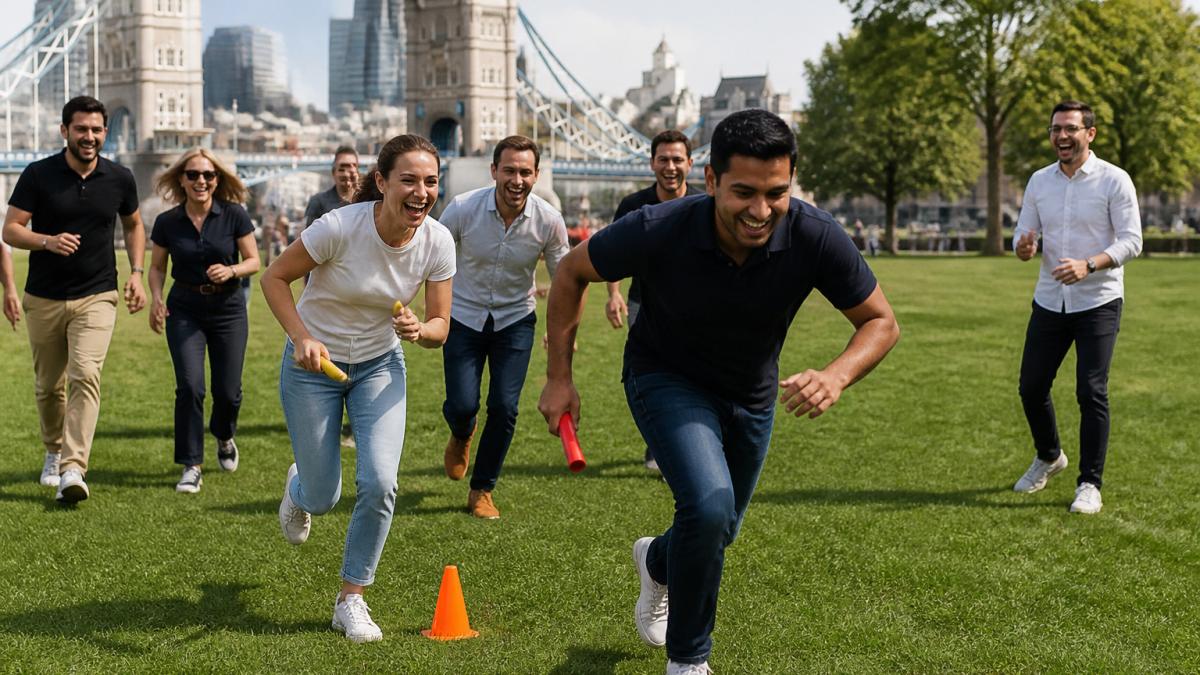
Relay games are a good starting point for teams that have never worked together outdoors. They are easy to explain, quick to run, and generate plenty of energy. The limitation is that a relay can reward speed over thought. For teams that need to plan, pair a relay with a short strategy task so the day covers both.
Check the park’s rules on booking, amplified sound and equipment before you commit.
Adventure Activities for Bolder Teams
Adventure activities, such as wilderness challenges, outdoor obstacle courses and speedboat or white-water experiences, create strong shared memories. They suit teams that are already comfortable with each other and want a bigger challenge.
These activities carry more physical risk and higher cost, so they need careful checking. Ask the provider about safety briefings, instructor qualifications, insurance cover and any fitness requirements. Be honest with your team about what they can manage, and offer a non-physical role for anyone who does not want to take part in the strenuous elements.
Adventure days can also create pressure to perform. Set expectations clearly beforehand so the activity builds trust rather than exposing weak spots.
Outdoor Team Building Ideas Near London by Team Size
Group size changes which formats are feasible, how long tasks take and how much each person actually does. Use the table below to shortlist, then confirm logistics with the provider.
| Group size | Formats that work well | Watch-outs |
|---|---|---|
| 6-12 | Orienteering, custom mission, escape-style trail | Fixed costs per head are high; ensure every person has a named role |
| 13-30 | Facilitated park challenge, team Olympics, multi-stage treasure hunt | Split into sub-teams of 5-7 so no one waits long between turns |
| 31-60 | Parallel relay tournaments, rotating checkpoint challenges | Need a central base and a clear schedule to avoid bottlenecks |
| 60+ | Staged programme with multiple activity zones and a shared debrief | Book early; confirm facilitator-to-participant ratios and toilet/refreshment capacity |
Match the format to the objective, not just the headcount.
- Onboarding or new teams: low-physical, high-interaction formats such as treasure hunts or clue trails let people talk while doing. Avoid pure physical competition, which can favour the already-confident.
- Communication across departments: multi-stage challenges that require handovers between sub-teams expose and practise information flow.
- Decision-making under time pressure: orienteering and checkpoint races with a strict clock force prioritisation.
- Morale and shared memory: adventure activities and team Olympics generate the strongest stories, but check fitness levels and offer non-physical roles.
- Leadership development: facilitated debriefs matter more than the activity itself, ask whether the provider includes a structured review.
Accessibility and mobility. Ask providers directly about step-free routes, the ratio of walking to standing, toilet facilities, and whether tasks can be adapted for participants with limited mobility or sensory needs.
Travel time. An activity 40 minutes from central London may suit a small team but discourage a larger group with staff spread across the city. Factor travel into the schedule and confirm meeting points in writing.
Season and weather. Consider seasonal conditions when planning outdoor formats. Always confirm the provider’s rainy-day plan.
Shortlist by objective first, then by group size, then by budget. A format that fits the headcount but not the goal will feel forced regardless of how well it is run.
Team Building Cost: What to Budget per Person
Pricing depends on the activity and what is included. Request itemised quotes to compare proposals.
| Format | Typical per-person range (GBP) | What usually drives the price |
|---|---|---|
| Self-guided treasure hunt or orienteering pack | £15-£35 | Printed or app-based clue packs, venue permits, prize |
| Facilitated park challenge or team Olympics | £35-£75 | Facilitator day rate, equipment hire, park permit, first aid |
| Multi-stage city-wide challenge with checkpoints | £50-£95 | Staffing at checkpoints, tech platform, venue bookings, refreshments |
| Adventure activity (obstacle course, speedboat, climbing) | £75-£150+ | Instructor ratios, specialist kit, insurance, transport |
| Full-day facilitated programme with debrief | £120-£250+ | Senior facilitator, bespoke design, room hire, catering, evaluation |
What to check in a quote. Ask for a line-by-line breakdown covering: facilitation and staffing; equipment hire and delivery; venue or park permit fees; public liability insurance; first aid cover; refreshments and catering; transport between venues; photography or video; and the rainy-day contingency (reschedule, indoor fallback, or refund). A quote that omits permits or insurance is not comparable to one that includes them.
Hidden costs to watch for. Park permits for organised group activity vary by borough and can add a fixed fee. Some providers charge a travel surcharge for sites outside Zone 1-2. Cancellation terms matter: check the notice period for a full refund and whether a weather cancellation counts as a provider cancellation or a client cancellation.
Budgeting rule of thumb. Most organisers find that a half-day facilitated outdoor challenge lands in the £45-£80 per-head band once permits, insurance and a facilitator are included, while a full-day adventure with transport and catering pushes past £120 per head. Set your budget per head first, then shortlist formats that fit, not the other way round.
Ask providers for an itemised quote before you compare prices.
For our own chocolate-making events, pricing depends on group size, dates and delivery location. Visit the International Chocolate Events website or make an enquiry for a current quote tailored to your team.
Booking Your Team Building Activity Day
Consider booking early for weekends and summer months. Give the provider your objective, your group size, your accessibility needs and your budget. A good provider will ask questions before suggesting an activity.
Confirm the practical details in writing. Share these details with your team in advance.
Our hands-on chocolate-making events are designed for groups from 10 to 100+ people. You can make an enquiry through the International Chocolate Events website to discuss your team’s needs.
Frequently Asked Questions
What are some great team building activities?
Strong options include treasure hunts, orienteering, park-based relay challenges and problem-solving tasks that need shared planning. Choose activities that match your group’s fitness level and the objective, such as communication, trust or creativity. Mixed formats work well, because a short physical challenge followed by a debrief lets teams reflect on how they worked together. Pricing varies by provider, group size and date, so request a written quote that itemises what is included.
How much does team building cost?
Costs depend on group size, the activity chosen, the duration, venue and whether facilitation and catering are included. Per-person pricing is the most useful way to compare quotes, so ask each provider for a figure that covers all elements. Build a contingency for transport and refreshments, which are often billed separately. International Chocolate Events does not publish fixed prices in this guide, so contact the team directly for a quote tailored to your group.
Which outdoor team building activities work well for large groups?
Activities that split people into smaller teams include treasure hunts, orienteering and relay games with rotating stations. Confirm that the venue and facilitator can manage the numbers without long waits. Clear briefings and a designated lead per team keep the day moving and stop larger groups feeling impersonal.
How long should a team building event last?
Plan breaks, and make sure the timing suits your colleagues’ travel and working commitments.
Outdoor team building works best when the activity matches your team’s size, fitness and objectives, and when you plan for the weather. Compare several options before you commit, and ask every provider for a clear breakdown of what is included.
