Last Updated: October 26, 2026
Quick Summary
International team workshops succeed when you define clear objectives first, then build an agenda that absorbs time zones, interpretation, and accessibility needs without collapsing the core experience. Effective international team workshops must prioritize intentional design over activity selection, with structured interaction time and equal participation across regions.
- Define your workshop objective in one specific sentence before selecting any activity or icebreaker.
- Build agendas in three layers: fixed anchors, flexible blocks, and buffers to accommodate time zones and interpretation lag.
- Break groups of 100 into cohorts of 12-15 parallel sessions so each gets direct facilitation and genuine interaction.
- Rotate meeting times across quarters so no region always takes the inconvenient time slot.
- Measure workshop success against your original objective using immediate feedback, behavioral change at 2-4 weeks, and business impact at 3-6 months.
Table of Contents
- Define Clear Workshop Objectives Before Selecting Activities
- Building a Team Building Workshop Agenda Template That Works
- Scaling Interactive Workshops for 100 Guests Without Losing Impact
- Managing Time Zones and Logistics for International Team Workshops
- Virtual Team Building Workshop Ideas for Remote and Hybrid Teams
- Best Practices for Hybrid Team Workshops With Equal Participation
- Measuring Workshop Success and Gathering Participant Feedback
- Plan Your Custom Workshop Experience
- Frequently Asked Questions
Define Clear Workshop Objectives Before Selecting Activities
The biggest mistake when planning international team workshops is choosing an activity first, the chocolate-making, the icebreaker, the scavenger hunt, and hoping people bond.
According to research on multidisciplinary team success, reflecting on past projects helps team members improve their skill sets and learn how to avoid previous setbacks, which means your workshop needs a clear purpose before you pick any activity.
Start here: What’s the actual problem you’re solving?
- Are people across time zones disconnected?
- Does your team lack psychological safety?
- Are silos preventing cross-functional collaboration?
- Do new hires need cultural integration?
Each needs a different approach: trust-building for silos, structured communication for psychological safety, cultural immersion for integration.
Write your objective in one specific sentence: “Our team will understand each other’s working styles and build trust across regions.”
Once your objective is clear, select an activity that directly supports it. The activity should serve the objective, not the reverse.
Building a Team Building Workshop Agenda Template That Works
A strong agenda is your roadmap; without one, even the best activity feels rushed.
Here’s what works: start with your total time, then work backwards. Build the agenda in three layers, fixed anchors, flexible blocks, and buffers.
Layer 1: Fixed anchors (do not move)
- Opening and objective setting
- The core activity block
- The debrief and close
Layer 2: Flexible blocks (can shrink or expand)
- Icebreakers
- Breakout rotations
- Reflection time
Layer 3: Buffers (protect these)
- Time-zone handover breaks
- Interpretation lag
- Accessibility pauses
For a half-day session (3-4 hours):
- Opening & objective setting: 15 minutes
- Icebreaker activity: 10-15 minutes
- Main workshop activity: 90-120 minutes
- Debrief & feedback: 15-20 minutes
- Buffer time: 10-15 minutes
For a full-day session (6-8 hours):
- Opening: 20 minutes
- Icebreaker: 15 minutes
- First activity block: 90 minutes
- Break: 15 minutes
- Second activity block: 90 minutes
- Lunch or extended break: 60 minutes
- Final activity or reflection: 60 minutes
According to Moving Mountains HR, weekly or bi-weekly 5-10 minute icebreakers are recommended for maintaining team cohesion, and monthly 15-30 minute communication-focused sessions support ongoing development. This means your agenda should include structured interaction time, not just activity time.
International agenda mechanics most templates miss:
- Time-zone rotation: Rotate the inconvenient slot quarter by quarter so no region always carries the 11pm call, and publish the rotation a year ahead.
- Interpretation buffers: Add 30-50% to every speaking block, a 10-minute briefing becomes 15 minutes because interpreters need turn-taking space.
- Cultural pacing: Build a 10-minute “ways of working” segment near the start so expectations are explicit rather than assumed.
- Accessibility pauses: Neurodivergent participants and those with caring responsibilities need predictable breaks, schedule them rather than improvising.
- Asynchronous pre-work: Send a 5-minute video or short survey a week ahead so live time is used for interaction, not information transfer.
Here’s a practical template you can adapt:
| Time | Activity | Duration | Notes |
|---|---|---|---|
| 09:00 | Welcome & objectives | 15 min | Clarify what you’re aiming for |
| 09:15 | Ways of working | 10 min | Agree norms, interpretation, breaks |
| 09:25 | Icebreaker | 10 min | Low-pressure connection |
| 09:35 | Main activity intro | 10 min | Explain the experience |
| 09:45 | Hands-on workshop | 90 min | Core engagement time |
| 11:15 | Break | 15 min | Rest & recharge |
| 11:30 | Debrief discussion | 20 min | Connect activity to team goals |
| 11:50 | Feedback & close | 10 min | Gather insights |
Build the agenda so the core activity block is identical across regions. If you split into regional sessions, the shared core keeps the experience comparable and makes debrief data easier to compare.
Do not fill every minute. An agenda with no buffer is the most common reason international sessions overrun and remote participants drop off before the debrief.
A good test: can a participant in another time zone read this agenda and know when they must be live, when they can be asynchronous, and when they’ll be asked to speak? If not, it isn’t international-ready.
Scaling Interactive Workshops for 100 Guests Without Losing Impact
Large groups feel impersonal by default. You’re managing logistics, not facilitating connection.
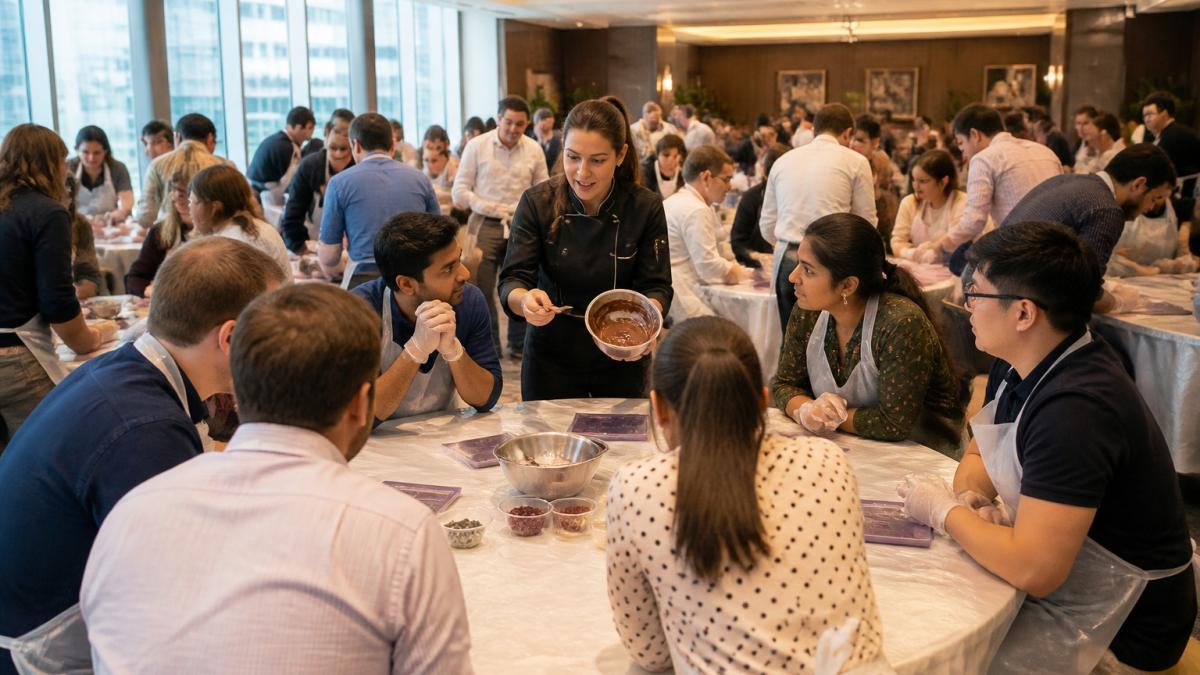
How to structure it:
- Run 6-8 simultaneous breakout sessions
- Rotate groups through different activities if you have time
- Assign a dedicated facilitator to each breakout group
- Use the same core activity so everyone shares the experience, but in smaller, more intimate settings
This works particularly well for international team workshops because it accommodates different energy levels, language comfort and participation styles.
International Chocolate Events offers scalable experiences for groups from 10 to 100+.
Watch out: Don’t assume all facilitators will deliver the same experience. Brief them on objectives, timing, and key discussion points beforehand.
For larger groups, also consider hybrid formats, some in person, others remote, which require clear camera angles, microphone setup and intentional inclusion of remote participants in breakouts. Explore deeper strategies for scaling interactive workshops for 100 guests.
Managing Time Zones and Logistics for International Team Workshops
This is where most international team workshops fail, not in the activity design, but in the logistics.
When your team spans continents, scheduling is a puzzle: 2pm UK time is 9am in New York and 11pm in Singapore. No single time works perfectly.
Your options:
- Rotate meeting times across quarters so no region always takes the inconvenient slot
- Record the session so asynchronous participants can join later (though this reduces live interaction)
- Split into regional sessions with the same activity, run by the same facilitator or trained staff
- Hybrid format with some participants in-person and others remote simultaneously
Beyond timing, consider:
- Travel logistics: Who travels, at what cost, and for how many days?
- Dietary requirements: Nut allergies, vegan and gluten-free needs, gather these weeks ahead.
- Accessibility needs: Mobility access, hearing loops, screen readers, quiet spaces for neurodivergent participants
- Language support: Interpretation services if your team speaks multiple languages
- Technology setup: Reliable WiFi, backup internet, clear audio/video quality
International Chocolate Events brings chocolate-making experiences to destinations globally. Explore our global events capabilities to learn more.
Virtual Team Building Workshop Ideas for Remote and Hybrid Teams
Virtual team building workshop ideas work best when interactive, not passive: a webinar where people watch isn’t a workshop; a session where people do something together is.
What works for remote workshops:
- Hands-on activities shipped to participants: Everyone receives ingredients or materials ahead of time. You facilitate live while people create at home. Chocolate-making kits, craft supplies, or cooking ingredients all work.
- Breakout room discussions: Use video conferencing breakout rooms for small group conversations. 4-5 people per room, rotating topics or facilitators.
- Collaborative tools: Miro boards, Figma, or Google Docs where teams ideate together in real-time.
- Asynchronous options: Record key sessions. Post discussion prompts. Let people contribute on their own schedule across time zones.
For international team workshops with remote participants, hybrid formats solve the time zone problem better than pure in-person events: some attend live in a physical location, others join from home, and everyone participates in the same activity simultaneously.
Best Practices for Hybrid Team Workshops With Equal Participation
Hybrid workshops only work if you design for equality. One camera in the corner will leave remote participants feeling excluded.
Equal participation requires intentional design:
Before the workshop:
- Test all technology 48 hours ahead. WiFi, cameras, microphones, screen sharing.
- Brief all facilitators on hybrid dynamics. In-person and remote groups need different attention.
- Send materials to remote participants early so they’re not scrambling during the session.
During the workshop:
- Position cameras at eye level so remote participants see faces, not the top of heads.
- Use a dedicated facilitator for remote participants to monitor chat, read body language via video, and ensure remote people speak.
- Rotate who speaks so in-person participants don’t dominate while remote people listen.
- Use breakout rooms that intentionally mix in-person and remote participants to force real interaction.
- Pause every 20-30 minutes to check in with remote participants directly. “What are you thinking?” beats hoping they’ll unmute.
According to True Colors International, hybrid workshop formats increasingly provide in-person and remote participants with equal, active roles, such as innovation hackathons, which is the future of team building at scale.
Watch out: Don’t run two separate workshops pretending they’re one. If in-person participants do a hands-on activity while remote people watch, you’ve failed. Either everyone participates actively, or you split into two genuinely separate sessions.
Measuring Workshop Success and Gathering Participant Feedback
You ran the workshop. Did it work, and was it worth the money?
Most teams skip this step, assuming engagement means success.
Measure these outcomes:
-
Immediate feedback (same day or next day)
- How relevant was this to your work?
- Did you connect with people you don’t normally interact with?
- Would you recommend this to other teams?
- Rate on a scale of 1-5. Aim for 4+.
-
Behavioural change (2-4 weeks later)
- Are people actually collaborating differently?
- Are cross-functional conversations happening?
- Did new relationships form and sustain?
-
Business impact (3-6 months later)
- Did project completion time improve?
- Did internal communication improve?
- Did retention improve?
Use a simple survey. Keep it to 5-7 questions. Send it within 24 hours while the experience is fresh.
Sample feedback questions:
- What was the most valuable part of this workshop?
- What would you change about the format or activity?
- Did this help you understand your teammates better? (Yes/No/Somewhat)
- Would you attend a similar workshop again? (Yes/No/Unsure)
- Any accessibility or logistical issues we should know about?
The gap most guides miss: budgeting and return on investment
Here is a practical framework for justifying the cost of an international workshop.
Step 5: Track a cohort over time. Re-survey the same group at 3 and 6 months. If collaboration scores hold, the workshop is working; if they decay, you have evidence for a follow-up session rather than a one-off event.
Measure the workshop against the objective you set at the start, not against how much people enjoyed the chocolate. Enjoyment is a leading indicator; business impact is the outcome.
Gallup reports that only 20% of employees worldwide were engaged in 2025, with low engagement costing the global economy £10 trillion in lost productivity. A well-designed international team workshop is one tool to move that needle, but only if you measure whether it actually worked, and can show the numbers to the people who signed off the budget.
Plan Your Custom Workshop Experience
You now have a framework for designing international team workshops that work.
Start with your objective. Define your audience. Choose your format, in-person, hybrid, or remote. Build your agenda.
International Chocolate Events offers bespoke, scalable chocolate-making experiences for groups from 10 to 100+.
Contact us for a bespoke quote and let’s design a workshop that actually moves the needle for your team.
Frequently Asked Questions
How do you handle dietary requirements and allergies in international team workshops?
Document dietary needs, including nut allergies and vegan or gluten-free requirements, and communicate them in advance. Ask the provider what options are available for your group.
What makes a team building workshop actually stick with participants after the event?
Research shows that reflecting on the workshop experience helps teams retain learning and improve their skill sets. Build in a post-event feedback session within one week, asking participants what they learned about each other and how they’ll apply it. Create a shared digital space where teams can continue collaboration. Monthly 15-30 minute follow-up communication sessions help reinforce the bonds and lessons from the workshop.
How do you manage international team workshops across multiple time zones?
When planning across time zones, consider scheduling the session at a time that works for participants and sharing the agenda in advance. Ask the provider which formats and arrangements are available.
What’s the minimum group size for an interactive international team workshop?
Interactive workshops work effectively with groups of 10 to 100+. The verified group-size range is 10 to 100+. Ask the provider how the experience will be structured for your group size.
The real measure of success isn’t the activity itself, it’s whether your team leaves with stronger relationships, clearer communication, and genuine commitment to each other’s success. That takes planning, intention, and the right partner to bring it to life.
