Table of Contents
- Why Scaling Interactive Workshops Beyond 50 Guests Changes Everything
- How to Structure a 100-Person Workshop That Holds Attention
- Large Group Facilitation Techniques That Actually Work
- Workshop Logistics Checklist for 100-Guest Events
- Remote, Hybrid, and In-Person Interactive Workshops at Scale
- Budget Optimisation and Day Delegate Rates for Large Groups
- Post-Workshop Knowledge Retention: Making the Impact Last
- Conclusion
Last Updated: August 26, 2026
Why Scaling Interactive Workshops Beyond 50 Guests Changes Everything
Scaling interactive workshops for 100 guests is fundamentally different from running sessions for 20 or 30 people. At International Chocolate Events, we’ve facilitated hands-on experiences for groups ranging from 10 to over 100 participants, and the shift past 50 people is where most event planners encounter their first real surprises. Logistics that were manageable at smaller scale become critical dependencies. A single point of failure, a missing dietary note, a poorly timed break, an under-briefed co-facilitator, ripples through the entire room.
The core tension in large-group workshop design is this: participants want to feel personally engaged, but logistics demand standardisation. According to Chartered Institute of Personnel and Development guidance on learning design, active learning approaches significantly outperform passive delivery for knowledge retention and participant satisfaction. That finding becomes even more consequential when designing for 100 people who all need to stay engaged simultaneously.
How to Structure a 100-Person Workshop That Holds Attention
A 100-person workshop that holds attention from start to finish requires deliberate architecture balancing information delivery, active participation, and recovery time.
Module-Based Agenda Design
Module-based structure divides a workshop day into discrete, self-contained units of 45-75 minutes, each with a clear learning outcome and defined activity type. This approach is far more effective at scale than a single flowing narrative because it gives participants natural reset points and prevents cognitive overload.
A practical module structure for a full-day 100-person workshop:
| Module | Duration | Format | Purpose |
|---|---|---|---|
| Welcome and icebreakers | 20 mins | Full group | Set tone, build energy |
| Module 1: Core concept | 50 mins | Plenary + table discussion | Knowledge transfer |
| Break | 15 mins | Free | Energy recovery |
| Module 2: Hands-on activity | 60 mins | Breakout groups | Active learning |
| Lunch | 45 mins | Social | Relationship building |
| Module 3: Application exercise | 55 mins | Breakout groups | Skill practice |
| Break | 15 mins | Free | Energy recovery |
| Module 4: Synthesis and reflection | 40 mins | Full group | Knowledge consolidation |
| Close and next steps | 15 mins | Plenary | Commitment and follow-through |
Each module should open with a clear objective stated aloud. Participants who understand why they’re doing something engage more deeply than those simply told what to do next.
Managing Breaks and Energy Levels Across a Full Day
Energy management is one of the most underestimated elements of large group facilitation. The post-lunch dip is predictable, schedule your most active, participatory module immediately after lunch rather than a passive presentation. Physical movement resets attention spans more effectively than coffee alone.
For groups over 80 people, build a five-minute “energiser” into the transition between every major module. A quick paired discussion question or show-of-hands poll prevents the attention drop that typically hits around the 90-minute mark.
Keep your facilitator briefed on energy cues: crossed arms, side conversations, and phones appearing signal the need to shift format, not push through.
Large Group Facilitation Techniques That Actually Work
The biggest mistake with large group facilitation is assuming that a technique working for 20 people simply scales up. Group dynamics shift at around 30 participants, and again at 60-70. Above those thresholds, the facilitator’s role changes from guide to conductor.
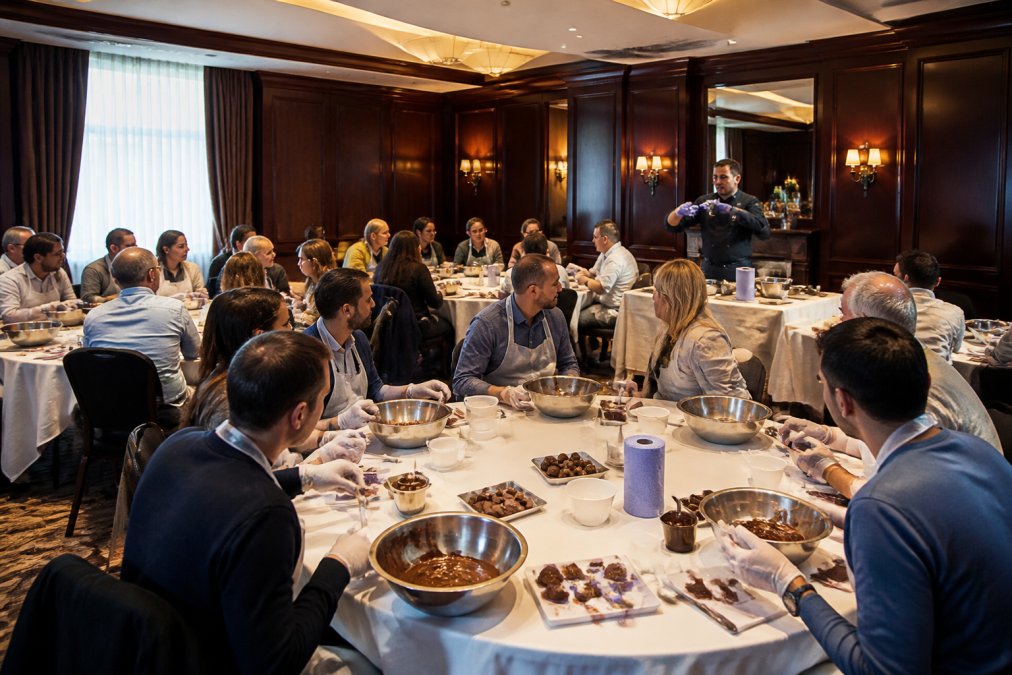
Large group facilitation techniques that work at the 100-person scale share three characteristics: they create structured interdependence between participants, they use time-boxing to maintain pace, and they give every person a visible role.
Time-boxing is particularly effective. Assign a fixed duration to every activity, "you have eight minutes to complete this as a table", and enforce it. Groups with deadlines produce better outputs and stay more focused than those working open-endedly.
Real-time feedback tools, such as digital polling platforms, allow every participant to respond simultaneously and see aggregated results within seconds, creating a shared data point the whole room can discuss.
Co-Facilitation: Why One Person Is Never Enough at Scale
One facilitator managing 100 participants is not facilitation. It’s crowd management.
Co-facilitation deploys multiple facilitators with defined, complementary roles. A well-structured model typically includes a lead facilitator responsible for the room’s overall energy and narrative, plus one support facilitator per 20-25 participants managing breakout activity, answering questions, and feeding back observations.
The briefing matters more than the facilitation itself. If co-facilitators aren’t aligned on objectives, timing cues, and escalation protocols before the session starts, the seams will show. Build a 30-minute co-facilitator briefing into every large-group event as non-negotiable.
Breakout Rooms and Table-Based Group Dynamics
Breakout rooms are the engine of participant engagement at scale. They transform a passive audience into active contributors and allow every person to speak.
For in-person workshops, table-based groups of five to seven people are optimal. Fewer than five creates uneven participation; more than eight and quieter participants disengage. Assign table roles explicitly: a timekeeper, a note-taker, and a spokesperson who reports back to the full group.
For virtual or hybrid sessions, keep breakout groups smaller, four to five participants maximum, to compensate for reduced social cues.
Avoid allowing participants to self-select into breakout groups at large-scale events. Self-selection reinforces existing social clusters and reduces the cross-functional connection that makes interactive workshops valuable for [team building](/chocolate-team-building/).
Workshop Logistics Checklist for 100-Guest Events
The logistics of a 100-person interactive workshop are where well-designed experiences either succeed or collapse. This operational layer is where event coordinators lose sleep.
Venue Setup and Training Venue Requirements
A training venue for 100 guests needs more than sufficient square footage. Space configuration directly affects how well facilitation techniques land.
Essential venue requirements for 100-person interactive workshops:
- Minimum 2.5 square metres per participant for seated workshop activity (250 sqm total floor space)
- Round or cabaret-style table configuration rather than theatre rows
- Adequate power points for digital tools and charging
- Clear sightlines to a central facilitation point from all tables
- Separate breakout space or adjacent rooms for sub-group work
- Reliable, high-bandwidth Wi-Fi capable of supporting 100+ simultaneous connections
- Natural light or adjustable lighting to manage energy levels
- Accessible facilities compliant with the Equality Act 2010
- Dedicated catering space separate from the workshop floor
- AV equipment including wireless microphones for a group of this size
Day delegate rates at conference venues typically bundle room hire, AV, catering, and support staff. Request an itemised breakdown to compare like-for-like across venues.
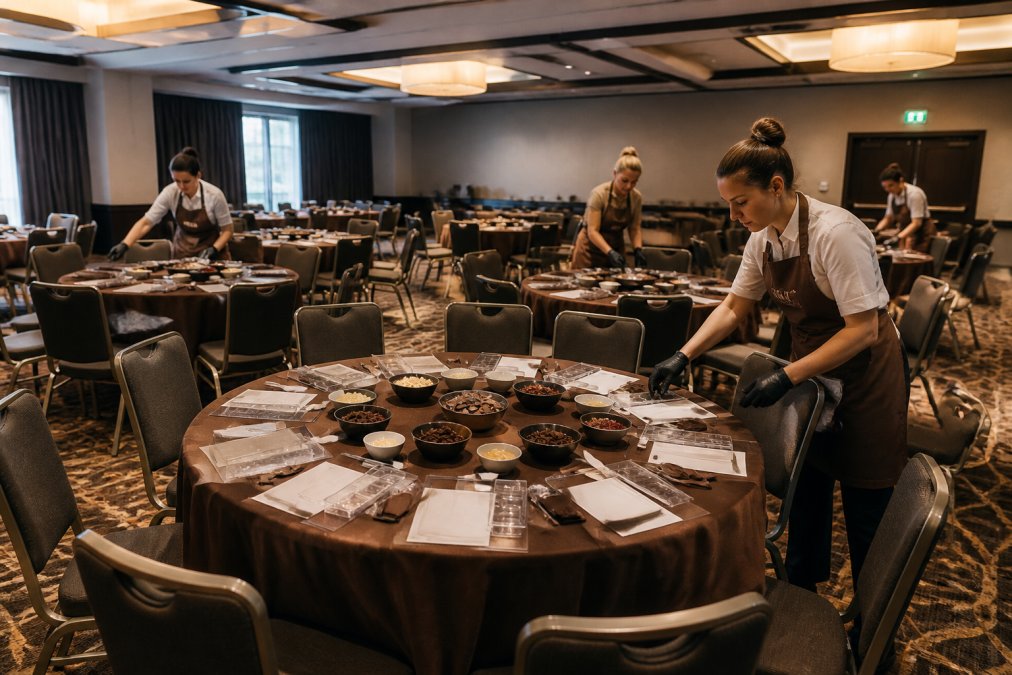
Dietary Requirements and Participant Experience
Dietary requirements at scale are a compliance and experience issue. Under the Food Information Regulations 2014, caterers must provide accurate allergen information for every dish served (food.gov.uk). For a group of 100 people, the likelihood of at least one serious allergy is high.
Collect dietary requirements at registration, not on the day. Group requirements into clear categories and communicate them to your catering team at least five working days before the event. For hands-on workshops involving food, ensure ingredient lists are available and workstations can accommodate allergen-free preparation.
Dietary accommodation is not a nice-to-have at scale. It’s the difference between a participant who feels included and one who watches everyone else during the hands-on portion.
Remote, Hybrid, and In-Person Interactive Workshops at Scale
Hybrid workshop dynamics are the most complex configuration to manage well. A hybrid workshop is not simply an in-person event with a video link, it is two simultaneous participant experiences that must be actively designed to feel equally valuable.
The core risk is that remote participants become passive observers rather than genuine contributors. Preventing this requires deliberate design choices:
- Assign a dedicated remote facilitator whose sole responsibility is managing the virtual cohort
- Use a digital whiteboard tool so remote and in-person participants contribute to the same shared canvas in real time
- Structure breakout groups to mix in-person and remote participants where possible
- Build in virtual signage, on-screen prompts, and timers that remote participants can see independently
For fully remote interactive workshops at 100-person scale, asynchronous preparation becomes powerful. Sending participants pre-work materials, context documents, or short video content before the session reduces scene-setting time and increases the proportion available for active collaboration.
According to ACAS guidance on hybrid working and team engagement, maintaining equitable participation between remote and in-person team members requires explicit structural support, not just good intentions.
Budget Optimisation and Day Delegate Rates for Large Groups
Budget optimisation for large-group workshops is less about cutting costs and more about understanding where spend creates participant value.
Day delegate rates at UK conference venues vary considerably. Always negotiate on the basis of confirmed headcount and request a minimum-guarantee clause rather than paying for 100 places if confirmed attendance is 85.
The areas where budget genuinely affects participant experience:
- Facilitation quality: Under-investing in experienced facilitators is the single most common cause of poor outcomes. A skilled co-facilitation team is worth more than premium venue décor.
- Materials and hands-on components: For experiential workshops, the tactile element is the memory anchor. Skimping on materials reduces post-workshop recall.
- Catering: Adequate, well-timed catering directly affects energy levels and engagement.
- Technology: Reliable AV and connectivity are baseline requirements.
For pricing specific to your group size and event format, contact International Chocolate Events directly to discuss bespoke options.
Post-Workshop Knowledge Retention: Making the Impact Last
Most workshop guides end at close of day. This is where the real work begins.
Post-workshop knowledge retention measures whether your investment in interactive workshops actually changed behaviour. Without deliberate reinforcement, participants forget the majority of new information within a week.
A practical post-workshop retention framework:
- Same-day summary: Send participants a concise recap within two hours of close, a three-paragraph narrative capturing the day’s throughline.
- 48-hour action prompt: A single follow-up message asking each participant to name one thing they’ve already applied or plan to apply within the week.
- Two-week check-in: A short group session or asynchronous survey to surface what’s working, what’s stuck, and what needs reinforcement.
- 30-day reflection: A structured conversation anchored to the workshop’s stated learning outcomes.
Building this container into your event plan from the start separates a team-building day people talk about for months from one they’ve forgotten by the following Friday.
Scaling interactive workshops for 100 guests requires careful planning across facilitation, logistics, energy management, and post-event reinforcement. International Chocolate Events designs bespoke, scalable experiences for groups from 10 to 100+, with a master chocolatier who handles everything from dietary customisation to co-facilitation structure, so your team leaves with a genuinely memorable experience that holds up long after the day itself. Make an enquiry to discuss your group size, location, and event goals.
Frequently Asked Questions
How do you maintain engagement in a workshop with 100 guests?
Break the group into tables of 8-10 from the start and assign each a facilitator or team lead. Use time-boxed activities so no single task runs longer than 20-25 minutes. Icebreakers at the opening, real-time feedback tools mid-session, and hands-on tasks, such as chocolate-making, keep participation high because every guest has a physical role rather than watching passively. Rotating group compositions between modules also prevents energy dips and builds broader connections across the room.
What are the essential logistics for hosting a 100-person event?
Confirm your training venue can seat 100 comfortably in a workshop layout, not theatre-style. Collect dietary requirements at registration, at least two weeks in advance. Plan one facilitator or assistant per 10-15 participants. Prepare a detailed run-of-show with timed transitions, designated breakout areas, and a technical troubleshooting protocol. For hands-on workshops, pre-stage all materials per table before guests arrive. A written workshop logistics checklist shared with all staff the day before prevents the most common on-the-day failures.
How do you structure a large-scale interactive workshop?
Use a module-based structure: open with a short icebreaker, move into two or three active learning blocks of 30-45 minutes each, schedule breaks at predictable intervals, and close with a group reflection or showcase. Each module should have a clear learning outcome so participants understand why they are doing each activity. For interactive workshops like chocolate-making, structure the modules around progressive skill-building, starting with simple techniques before moving to more creative, personalised tasks.
Can a chocolate-making workshop genuinely work as team building for 60 or more people?
Yes, provided the event is designed for scalability from the outset. A well-run chocolate workshop assigns small groups to dedicated workstations, each guided through the same hands-on process simultaneously. The shared creative challenge, combined with a tangible product guests take home, creates a memorable experience that reinforces collaboration. Post-event surveys from corporate groups consistently show that hands-on culinary workshops score highly on both enjoyment and perceived team cohesion compared with passive or lecture-based formats.
This article was written using GrandRanker