Table of Contents
- What Mobile Chocolate Making Workshops Actually Involve
- Corporate Team Building Chocolate Workshop: What Makes It Work
- Duration of Corporate Chocolate Making Events
- Space, Equipment, and Setup for Mobile Chocolate Workshops
- Mobile Workshop Health and Safety Requirements
- Sustainability, Sourcing, and Customisation Options
- Chocolate Workshop Event Planning Checklist
- Conclusion
What Mobile Chocolate Making Workshops Actually Involve
A mobile chocolate workshop is a fully self-contained culinary experience brought directly to your venue. The facilitator arrives with all equipment, ingredients, and packaging, sets up the workspace, guides participants through hands-on techniques, and dismantles everything at the end. Guests leave with handmade chocolates they’ve crafted themselves, a detail that matters because it creates lasting recall rather than fading like a generic team lunch.
The core session typically covers artisan chocolate fundamentals: tempering chocolate to achieve the correct snap and gloss, filling and sealing moulding trays, creating chocolate ganache centres, and decorating finished pieces. More involved formats extend into flavour pairing exercises, where participants experiment with combining ingredients such as sea salt, chilli, or freeze-dried fruit with couverture chocolate. The Truffle Express format focuses tightly on truffle making, giving groups a satisfying outcome within a compact timeframe.
What distinguishes a well-run mobile setup from a poorly planned one is pre-event coordination. Venue requirements, group dietary needs, power access, and table configuration all need confirming before equipment leaves the facilitator’s vehicle. Done properly, the logistics are invisible to participants, they simply arrive, get involved, and leave with something delicious.
Corporate Team Building Chocolate Workshop: What Makes It Work
A corporate team building chocolate workshop works because it removes hierarchy from the room. A director and a graduate trainee are equally likely to struggle with their first tempering attempt, and that shared vulnerability is genuinely bonding in a way a presentation or quiz night rarely achieves.
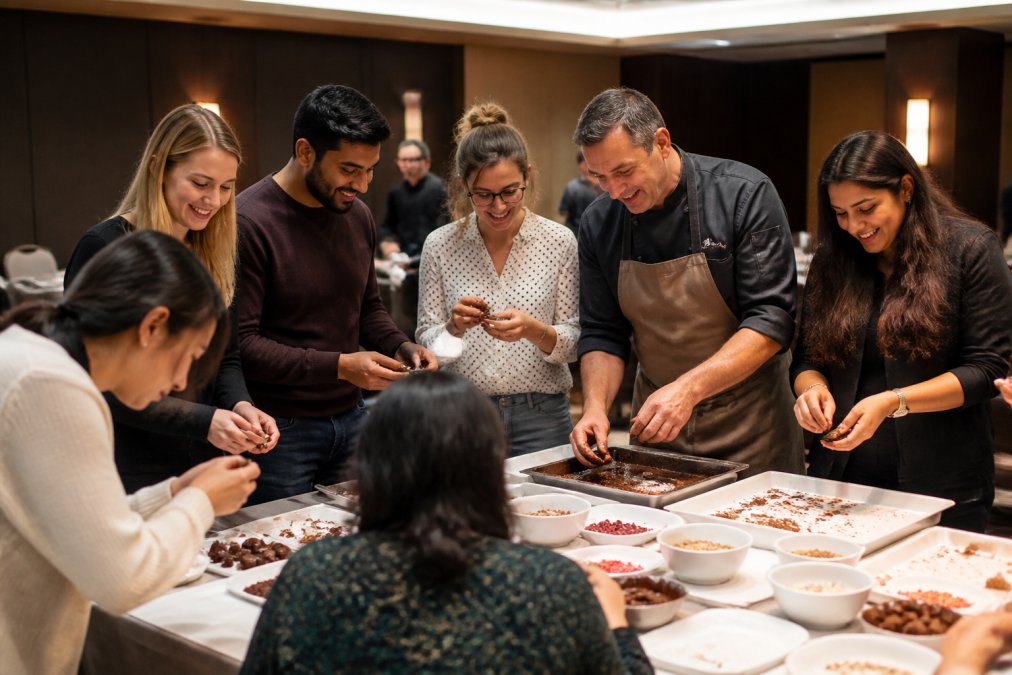
The structure of the session matters enormously. The best corporate chocolate workshops start with straightforward tasks, filling a mould or dipping a truffle, to build confidence before participants attempt more technically demanding work. By the time the group reaches flavour pairing or decoration, the room is relaxed, engaged, and genuinely collaborative.
As CIPD’s research on employee engagement and learning consistently highlights, experiential learning involving physical activity and social interaction produces stronger retention and more positive emotional associations than passive formats. A hands-on culinary experience sits squarely in that category.
Personalisation also matters. When a company’s branding appears on the packaging or the session is themed around a product launch or milestone, participants connect the experience to their organisation rather than treating it as a generic away-day activity. That connection generates post-event conversation.
Techniques That Drive Participant Engagement
Techniques that feel genuinely skilled rather than trivially easy generate the most engagement. Tempering chocolate by hand requires attention to temperature and texture, and the moment participants feel the chocolate tighten and become workable is genuinely satisfying. Moulding and unmoulding, when done correctly, produces a professional-looking result that participants are proud to photograph and share.
Ganache making is high-engagement because it involves sensory judgement: participants adjust consistency, taste for balance, and decide when the mixture is ready. Flavour pairing exercises add a creative dimension that suits groups responding well to open-ended challenges. The combination of precision tasks and creative choices holds the attention of mixed groups without anyone feeling bored or overwhelmed.
Duration of Corporate Chocolate Making Events
Corporate chocolate making events typically range from 90 minutes to three hours, depending on complexity and group size. A 90-minute format suits groups looking for a focused, high-energy activity within a half-day agenda. A two-to-three-hour session allows for more techniques, a slower pace, and fuller immersion.
For most corporate bookings, a two-hour session hits the practical sweet spot. It’s long enough to cover tempering, moulding, and decoration with time for the facilitator to explain the science behind each stage, but short enough to hold attention without fatigue. Groups including a formal tasting or flavour pairing element generally benefit from additional time.
Scaling for Groups of 15 to 100+
Scaling a chocolate workshop for larger groups requires a fundamentally different operational approach. For groups of 15 to 30, a single facilitator with one or two assistants can maintain a genuinely personal, interactive session. Above 30 participants, the format typically shifts to team-based structures where groups of six to eight work at their own station, with the lead facilitator demonstrating to the whole room and assistants circulating to support individual tables.
For groups of 60 to 100 or more, the event becomes a coordinated production requiring multiple facilitators, staged setup, and careful logistics around ingredient distribution and equipment placement. The key is ensuring participant engagement doesn’t suffer as numbers increase. Breaking a large group into competing teams with a judged final tasting is one approach that scales well and adds competitive edge many corporate groups respond to positively.
International Chocolate Events designs scalable formats specifically to avoid the impersonal feel large group events often produce. The bespoke structure means the experience adapts to the group rather than the group adapting to a fixed format.
Space, Equipment, and Setup for Mobile Chocolate Workshops
Each participant needs approximately 60 to 70 centimetres of clear table width and at least 50 centimetres of depth for their working area. For a group of 40, that translates to roughly 24 to 28 linear metres of table space, a practical planning figure worth confirming early.
The room itself needs to be cool, ideally between 18°C and 21°C. Chocolate is highly sensitive to ambient temperature: a warm room causes tempering problems and prevents finished pieces from setting correctly. Air conditioning or adequate ventilation is a genuine requirement, not a preference.
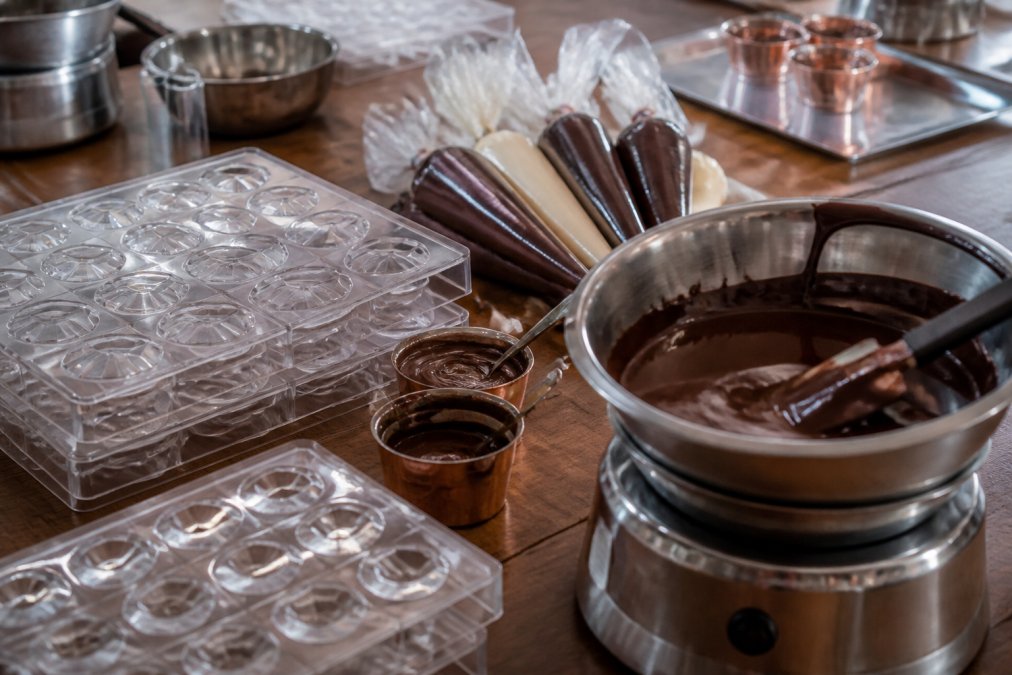
Equipment brought to a mobile session typically includes tempering equipment and heat-resistant bowls, moulding trays in multiple formats, piping bags and scrapers, ganache preparation equipment, decoration materials and flavouring agents, packaging and take-home boxes, and hygiene supplies including gloves, aprons, and surface covers.
Temperature Control and Equipment Breakdown
Temperature control is the single most critical technical requirement in mobile chocolate work. Couverture chocolate must be tempered within a precise range, typically 31°C to 32°C for dark chocolate and slightly lower for milk and white varieties, to achieve the crystalline structure that gives finished chocolates their characteristic snap and shine. Outside this range, the chocolate will either be too thick to work with or will set with a dull, streaky finish.
Mobile setups address this through portable tempering equipment designed for field use. The facilitator monitors ambient room temperature throughout the session and adjusts working methods accordingly. In venues that cannot be adequately cooled, the facilitator may modify techniques to compensate, for example by working in smaller batches or adjusting tempering times.
Mobile Workshop Health and Safety Requirements
Mobile workshop health and safety requirements are governed by several overlapping frameworks in the UK. Any food handler operating professionally must comply with the Food Safety Act 1990 and associated Food Hygiene Regulations, which cover safe food handling, storage temperatures, and hygiene standards for equipment and surfaces.
The facilitator is responsible for ensuring all surfaces are cleaned and covered before ingredients are placed, that all equipment is food-safe and maintained to commercial standard, and that participants are briefed on basic hygiene practices before handling ingredients. This typically includes a short allergen awareness briefing at the start of the session.
Risk assessment documentation should be prepared in advance for each event, covering the specific venue layout, any equipment with heat or electrical risk, and participant movement around the workspace. For corporate events at venues with their own health and safety requirements, it is standard practice to share risk assessments with the venue coordinator prior to the event date.
Allergen Management and Dietary Customisation
Allergen management is one of the most frequently raised concerns in pre-event enquiries, and rightly so. Chocolate workshops involve ingredients carrying the 14 major allergens listed under UK allergen labelling regulations derived from Regulation (EU) No 1169/2011, including milk, nuts, soya, and gluten-containing cereals. A professionally run mobile workshop must have a clear process for identifying participant allergens, segregating ingredients, and communicating substitutions clearly.
For groups with nut allergies, this means using nut-free couverture and ensuring decoration materials and flavourings are sourced from nut-free production environments. Vegan participants can be accommodated using high-quality dairy-free dark chocolate and plant-based ganache recipes. Gluten-free requirements are generally straightforward to meet, as most chocolate work does not involve wheat-based ingredients, but cross-contamination from shared equipment must be considered.
The practical approach is to collect dietary requirements at the booking stage, confirm substitutions with the facilitator in advance, and brief participants at the start of the session on which stations or ingredients apply to them. Customisation at this level is a baseline requirement, not an optional extra.
Sustainability, Sourcing, and Customisation Options
Many corporate clients now ask specifically about the provenance of chocolate used in their events. Ethically sourced couverture, certified to standards such as Fairtrade or Rainforest Alliance, is available from specialist suppliers and represents a meaningful choice rather than a marketing gesture.
According to the Fairtrade Foundation’s guidance on cocoa sourcing, the cocoa supply chain involves significant complexity around pricing and farmer welfare, and certification schemes provide a practical mechanism for organisations that want their purchasing decisions to reflect their stated values. For a corporate event, using certified chocolate aligns the activity with a company’s sustainability commitments.
Customisation options extend well beyond ingredient sourcing. Branded packaging, custom mould shapes, bespoke flavour combinations developed in consultation with the client, and themed decoration schemes are all achievable within a mobile workshop format. For product launches or milestone celebrations, finished chocolates can be designed to reflect the occasion directly, creating a take-home item that functions as both a memento and a conversation piece.
Confirm customisation requirements at least three weeks before the event date. Bespoke mould production and branded packaging both require lead time that cannot be compressed at short notice.
Chocolate Workshop Event Planning Checklist
The logistics of mobile chocolate making workshops require structured pre-event planning to run without issues on the day. Use this checklist to confirm that all operational requirements are in place before the event date.
| Planning Stage | Action Required | Timeframe Before Event |
|---|---|---|
| Initial booking | Confirm group size, date, venue, and session format | 6-8 weeks |
| Dietary requirements | Collect all allergen and dietary information from participants | 4 weeks |
| Venue confirmation | Confirm table dimensions, room temperature, power access | 3 weeks |
| Customisation brief | Finalise branded packaging, mould shapes, flavour choices | 3 weeks |
| Risk assessment | Share facilitator risk assessment with venue coordinator | 2 weeks |
| Participant briefing | Send pre-event information including dress code and session outline | 1 week |
| Day-of logistics | Confirm facilitator arrival time and access arrangements | 48 hours |
| Post-event | Collect participant feedback and confirm take-home packaging | Day of event |
Pre-event checklist:
- Group size confirmed and catered for in equipment quantity
- All dietary requirements and allergens documented and communicated to facilitator
- Venue room temperature verified as suitable (18°C to 21°C)
- Adequate table space confirmed (minimum 60-70cm per participant)
- Power access for tempering equipment confirmed with venue
- Allergen-safe ingredient substitutions confirmed in writing
- Risk assessment reviewed and signed off by venue health and safety contact
- Branded or bespoke packaging ordered with sufficient lead time
- Participant briefing sent with session expectations and hygiene guidance
- Facilitator arrival window and venue access confirmed
Failing to confirm room temperature in advance is the most common avoidable problem in mobile chocolate events. A warm venue will prevent chocolate from tempering correctly, and there is no quick fix on the day. Always get a written confirmation from the venue that the room can be maintained below 21°C.
A common mistake is leaving dietary requirement collection until the week before the event. By that point, ingredient substitutions may not be sourceable in time, and the facilitator has insufficient notice to adapt the session plan. Build the dietary data collection step into your initial booking confirmation process.
The difference between a smooth mobile chocolate workshop and a stressful one almost always comes down to pre-event communication. Every operational problem that surfaces on the day was a question that wasn’t asked four weeks earlier.
Running a mobile chocolate workshop for a group of any size is a genuinely achievable event format, but the operational complexity is real and deserves proper attention. International Chocolate Events handles the full scope of that complexity, from allergen management and temperature-controlled equipment to bespoke packaging and scalable facilitation for groups from 10 to 100 or more. If you’re planning a corporate team building event, a private celebration, or a large-scale off-site, make an enquiry with International Chocolate Events to discuss the specifics of your event and receive a tailored proposal.
Frequently Asked Questions
What equipment is required for a mobile chocolate making workshop?
A mobile chocolate workshop typically requires portable tempering equipment, moulding trays, ganache preparation tools, piping bags, and temperature-controlled storage for ingredients. A professional workshop facilitator will also bring protective workwear, allergen-separated ingredient sets, and packaging for guests to take their finished confectionery home. The host venue only needs to supply adequate table space, access to standard power sockets, and a nearby water source.
How much space is needed to host a corporate chocolate workshop?
As a general guide, plan for roughly 0.75 to 1 square metre of clear table space per participant, plus a separate facilitator preparation area of around 2 to 3 square metres. For a group of 40, a standard conference or banquet room of approximately 60 to 80 square metres is usually sufficient. The workshop provider will confirm exact requirements during the booking process based on your group size and chosen format.
Do mobile chocolate workshops require specific health and safety certifications?
Yes. Any provider handling food at a mobile event must comply with the Food Safety Act 1990 and the Food Hygiene (England) Regulations 2006, and should hold a current Food Hygiene Certificate. Public liability insurance is also standard. Reputable providers will carry documented allergen information in line with relevant UK allergen labelling regulations, ensuring every participant is informed about ingredients before the session begins.
How long does a corporate chocolate making event typically last?
Most corporate chocolate making events run between 90 minutes and three hours, depending on the techniques covered and the group size. A focused truffle-making session for a team of 20 can comfortably fit into 90 minutes, while a full bespoke workshop covering tempering, moulding, and flavour pairing for 60 or more participants often benefits from a two-to-three-hour format. Your event coordinator can tailor the duration to fit your schedule.
This article was written using GrandRanker