
Quick Summary
Dessert board styling starts with choosing a wide, flat surface such as wood or slate, then selecting three or four premium chocolates that each play a different role. Arrange the largest items first and fill gaps with smaller sweets, keeping the board cool throughout.
- Choose a wide, flat surface such as a light wood board or slate tile.
- Pick one dark, one milk and one white chocolate, plus a fourth wildcard bar.
- Look for cocoa butter rather than vegetable fat in white and milk chocolate.
- Arrange the largest items first, then fill gaps with smaller sweets.
- Keep the board away from heat and humidity to prevent chocolate bloom.
Table of Contents
- Choosing the Right Board and Serving Surface
- Selecting Premium Chocolate Varieties and Formats
- How to Arrange a Dessert Board From Large Items to Small
- Chocolate Handling, Make-Ahead Timing and Keeping It Cool
- Planning Your Dessert Board for a Party or Gathering
- Booking a Chocolate Board Styling Session With International Chocolate Events
- Frequently Asked Questions
7 Luxury Chocolate Dessert Board Styling Tips
Last Updated: November 16, 2026
Choosing the Right Board and Serving Surface
Dessert board styling starts with the surface beneath a luxury chocolate board. International Chocolate Events works with hosts who want a board that looks as considered as the chocolate on it, so the choice of base matters more than many people expect.
A large, flat wooden board or slate tile gives you room to build. Marble works well for keeping chocolate cool, though it can feel cold to the touch.
- Choose a surface wide enough to hold large items and small items together
- Use a light wood or dark slate to make chocolate colours stand out
- Avoid surfaces that will stain, such as unsealed timber
Watch out: do not place a board directly on a warm worktop or near an oven. Heat softens chocolate quickly and can ruin the surface you have chosen.
Selecting Premium Chocolate Varieties and Formats
The chocolate itself sets the tone for the whole board, and on a luxury board the selection should read as deliberate rather than as a supermarket assortment. Those who want to go further can try a hands-on chocolate making experience to learn how different chocolates are crafted.
Start with three or four chocolates that each do a different job. A single-origin dark bar at 70-75% cacao gives depth and a clean bitterness that cuts through sweet fruit. A milk chocolate at around 40-45% cacao is familiar and comforting, and a good one will taste of caramel or malt rather than just sugar. White chocolate adds a soft, creamy contrast in colour and works best when it is real white chocolate, check that the label lists cocoa butter rather than vegetable fat.
Cacao percentage is the single most useful label detail for guests. A 70% bar and an 85% bar taste very different, and printing the percentage on a small card beside each pile turns the board into a tasting rather than a buffet.
Mix formats as well as flavours. Chocolate bars broken into shards, truffles, chocolate-dipped pretzels and small bonbons all give the board a different texture and a different scale.
- Choose one dark, one milk and one white as the base, then add a fourth wildcard such as a ruby or a single-origin bar
- Look for cocoa butter rather than vegetable fat in white and milk chocolate
- Include at least one bar with a printed cacao percentage so guests can compare
- Add one artisanal accompaniment, cocoa nibs, candied orange, or a sea-salt chocolate, to lift the board above the ordinary
Watch out: white chocolate and some milk chocolates scorch or seize easily, so avoid buying a bar that has already bloomed with a greyish film; it will look dull on a luxury board even if it is still safe to eat.
The article recommends a small set of chocolates, each chosen for a specific role on the board.
| Chocolate | Cacao or label guide | Role on the board |
|---|---|---|
| Dark, single-origin bar | 70-75% cacao | Depth; cuts through sweet fruit |
| Milk chocolate | 40-45% cacao | Familiar, comforting; caramel or malt notes |
| White chocolate | Look for cocoa butter | Soft, creamy contrast in colour |
| Wildcard bar | Ruby or single-origin | Fourth option to add interest |
How to Arrange a Dessert Board From Large Items to Small
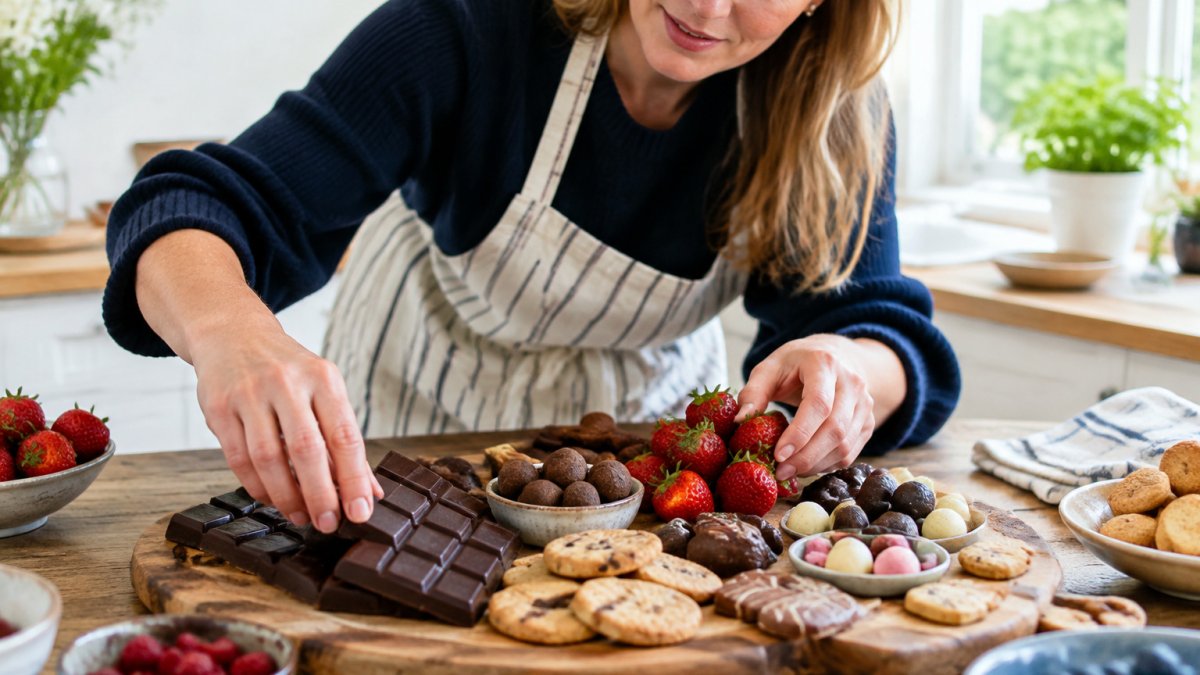
Arrange the largest items first, then fill the spaces with smaller ones. This is the simplest way to build a board that looks generous rather than crowded.
- Place the largest chocolate bars or a bowl of dips near the centre of the board.
- Position larger fruit, such as fresh figs or halved apricots, around the main items.
- Add cookies, brownies or slices of cake in the gaps between them.
- Scatter truffles, candies and berries into the smaller spaces last.
Step back after each stage and check the balance. A board that looks even from one side will usually look good from all sides.
Chocolate Handling, Make-Ahead Timing and Keeping It Cool
Chocolate is sensitive to heat, humidity and time, and a board that looks polished at 6pm can look dull by 8pm if it has not been handled with care. Plan the timing so the board stays in good condition until guests arrive.
Keep the board in a cool room, away from direct sunlight, radiators and the heat of an oven. A common pattern is for hosts to set the board up in a warm kitchen and then wonder why the chocolate has lost its shine. If the room is warm, store the board in the fridge and bring it out 30 minutes before serving so the chocolate reaches a pleasant temperature without condensation forming on the surface.
Humidity matters as much as heat. Keep the board away from open windows, kettles and dishwashers, and avoid placing it directly over a sink.
Assemble the fresh fruit closer to the time, since berries can soften or weep and leave juice on the board. Wrap the finished board loosely in cling film if it must travel, and unwrap it only once it is in position so the surface does not pick up fridge smells.
If the board is out for a long evening, set out a smaller amount and refill from the fridge rather than leaving everything out at once.
Watch out: sudden temperature changes cause chocolate bloom, the greyish streaks that look like mould but are harmless sugar or fat crystals, so never move a cold board straight into a hot room or vice versa.
Planning Your Dessert Board for a Party or Gathering
A board for a party needs more planning than a board for two people. Count your guests first to plan the size of your dessert spread.
Think about dietary needs before you shop. Label nut-containing items clearly, offer a dairy-free or vegan option, and keep gluten-free biscuits separate so guests can choose safely.
Pair the board with drinks. Coffee, dessert wine and sparkling water all suit chocolate. A simple list of pairings on a card beside the board helps guests try new combinations.
For bigger groups, make two smaller boards instead of one huge one. Guests can gather around each board, which feels more personal.
Booking a Chocolate Board Styling Session With International Chocolate Events
If you want hands-on help, International Chocolate Events can run a styling and chocolate-making session for your group. Sessions can be booked for groups of 10 to 100+ people, and the team can tailor the content to your guests and your venue.
To find out what is available in your area, make an enquiry with the team. Pricing depends on quantity, dates and delivery, so request a quote for an accurate figure.
If you are planning a team day or a private party further afield, browse the events the team offers. You can also contact International Chocolate Events to ask about a bespoke quote for your group.
For a taste of the craft before you style your own board, consider the Truffle Express for a fun, interactive session.
Ready to make your next gathering memorable? Get in touch with International Chocolate Events to plan a chocolate experience that suits your guests. Our team can help you build an event that feels indulgent, interactive and entirely your own.
Frequently Asked Questions
How do you arrange a chocolate dessert board?
Start with the largest items, such as chocolate bars or a bowl of dips, and place them at intervals across the board to create focal points. Next add medium pieces like brownies, figs and fruit clusters, then fill the remaining spaces with truffles, sweets and small biscuits. Work in clusters rather than rows so the board looks abundant and natural, and step back every few minutes to check the balance of colour and height.
How much chocolate should you allow per person?
Adjust the amount of chocolate for how many guests are likely to take a second helping and whether children are attending. Adjust for how many guests are likely to take a second helping and whether children are attending. Mixing dark, milk and white chocolate gives guests choice without needing large quantities of each.
Which fruits pair best with chocolate on a dessert board?
Strawberries, raspberries, orange segments, dried apricots and figs all pair well with dark and milk chocolate. Choose fruit that is firm and dry, since excess moisture can soften chocolate and make the board look untidy. Add fruit close to serving time, and keep wet fruit separate from dipped items where possible. Mixing fresh and dried fruit gives contrast in both texture and colour.
How far in advance can you prepare a chocolate dessert board?
Add fresh fruit and any dips at the last moment before guests arrive. Keep the assembled board in a cool room away from direct sunlight, since chocolate softens quickly in warm conditions.
